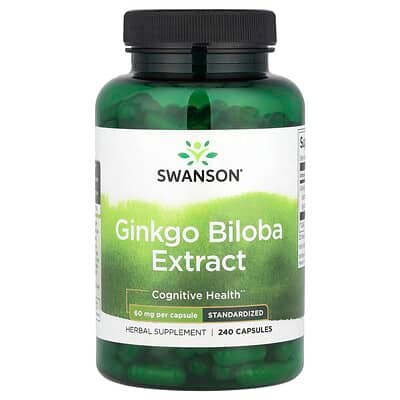
Product Image

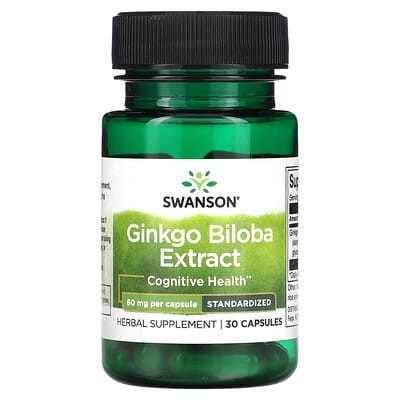
Ginkgo Biloba 24% 60 mg

Swanson Premium Brand
4.8
★ ★ ★ ★ ★
(7396 ratings)
Ginkgo
Product Image
Score81
A modest ginkgo serving for circulation-related cognitive use. The product name indicates flavone standardization, but the terpene-lactone percentage and a low-ginkgolic-acid guarantee are missing.
How scoring works
Quantity:30 Capsule(s) • (30 servings)
Goals:
Vision Support

Score 81

A modest ginkgo serving for circulation-related cognitive use. The product name indicates flavone standardization, but the terpene-lactone percentage and a low-ginkgolic-acid guarantee are missing.
How scoring works
$4.19($0.13 per serving)
iHerb
$ 4.19
Amazon
$ 0.00
iHerb
$ 4.19
Report prices

Analysis

The capsule provides 60 mg ginkgo extract, targeting cerebral and peripheral circulation. The amount is better suited to light maintenance than a strong standalone regimen.

Ginkgo may support selected memory, focus, or circulation-related outcomes, but it is not a broad nootropic. Its vision relevance is also narrow because it does not supply lutein, zeaxanthin, retinal omega-3 fats, or antioxidant minerals.

The product name indicates flavone standardization, but the terpene-lactone percentage and a low-ginkgolic-acid guarantee are missing. The focused format is easy to understand, though extract quality matters more than raw leaf weight or package size.

Who is it for
  • Adults seeking focused ginkgo supplementation
  • Users interested in circulation-related cognitive support
  • People who prefer a capsule
Best for
  • Targeted ginkgo use
  • Memory and focus routines in suitable adults
  • Users seeking a single-botanical formula

Pros

  • Ginkgo amount is clearly listed
  • Focused formula is easy to assess
  • Modest amount may suit light maintenance
  • Stimulant-free botanical

Cons

  • Does not provide broad cognitive pathway coverage
  • Not a complete vision formula
  • Extract standardization is incomplete
  • No complementary nutrients are included

Warnings

  • Ginkgo may add to warfarin, direct oral anticoagulants, aspirin, or other antiplatelet effects and increase bleeding risk
  • Stop ginkgo before surgery or an invasive procedure when directed by the treating clinician because of its bleeding effects
  • Ginkgo may cause headache, dizziness, or digestive upset in sensitive users

Nutrient quality

82 Highest impact

Flavone standardization supports baseline extract quality for maintenance use. The modest amount and incomplete marker profile limit depth for the stated vision goal.

.
Ingredient transparency

80 High impact

Active amounts and marker names are disclosed without a hidden blend. Complete standardization, daily-use directions, and non-active ingredients remain unavailable.

.

Customer satisfaction

72 High impact

The available rating is strong and the sample is very large. Detailed feedback was not supplied, so repeated complaints and alignment with the intended use remain uncertain.

.

Value for money

90 Highest impact

The low purchase cost supports good value for maintenance use. The short supply and incomplete standardization keep it from leading the category.

.

Report analysis

Goals

Vision Support
Impact
Moderate effect
D Goal FitC Strength of SupportF CoverageA Formula Quality

Standardized ginkgo may support ocular blood flow, but it is not a core macular or retinal nutrient. The amount is modest and the full active-marker profile is not established.

The label names flavone glycosides and terpene lactones while omitting a low-ginkgolic-acid guarantee. Ginkgo may increase bleeding risk with anticoagulant or antiplatelet medicines.

Study evidence
Ginkgo Supportive 11 studies

Ingredients

IngredientAmount per serving
Ginkgo biloba leaf extract (Flavone Glycosides, Ginkgolic Acid, Terpene Lactones)
60 mg
Adults 18–50 Women
Report overview
D- Active Ingredient Quality & BioavailabilityB+ Dose, Safety & Label TransparencyB Value

The label indicates flavone standardization and names terpene lactones, but it does not establish the full target marker profile. The dose is suited to mild maintenance, and no low-ginkgolic-acid guarantee is provided. The standardized cost is favorable. Ginkgo may increase bleeding risk when combined with anticoagulant or antiplatelet medicines.

Loading alternative details
Report alternatives

Sources

Published studies used for the product analysis and the top-ranked studies for each ingredient and goal.

  1. Effect of Ginkgo biloba extracts in the prevention of posterior capsule opacification after cataract surgery: A randomized clinical trial.
    Amiri AA; Jafari R; Amiri AA; Rad HA; Daneshvar F; Charati JY; Amiri AA · Oman journal of ophthalmology · 2025
    Randomized trial144 participantsVision Support forGinkgo
  2. Electrophysiological analysis of the effects of ginkgo biloba on visual processing in older healthy adults.
    Page JW; Findley J; Crognale MA · The journals of gerontology. Series A, Biological sciences and medical sciences · 2006
    Clinical trialVision Support forGinkgo
  3. Ginkgo biloba--an appraisal.
    Dubey AK; Shankar PR; Upadhyaya D; Deshpande VY · Kathmandu University medical journal (KUMJ) · 2007
    Narrative reviewVision Support forGinkgo
  4. [Ginkgo extract in impaired vision--treatment with special extract EGb 761 of impaired vision due to dry senile macular degeneration].
    Fies P; Dienel A · Wiener medizinische Wochenschrift (1946) · 2002
    Randomized trial99 participantsVision Support forGinkgo
  5. Effect of Ginkgo biloba extract on preexisting visual field damage in normal tension glaucoma.
    Quaranta L; Bettelli S; Uva MG; Semeraro F; Turano R; Gandolfo E · Ophthalmology · 2003
    Randomized trial27 participantsVision Support forGinkgo
  6. Short-term effects of Ginkgo biloba extract on peripapillary retinal blood flow in normal tension glaucoma.
    Park JW; Kwon HJ; Chung WS; Kim CY; Seong GJ · Korean journal of ophthalmology : KJO · 2012
    Randomized trial30 participantsVision Support forGinkgo
  7. [The course of color vision in early diabetic retinopathy treated with Ginkgo biloba extract. A preliminary double-blind versus placebo study].
    Lanthony P; Cosson JP · Journal francais d'ophtalmologie · 1989
    Randomized trial29 participantsVision Support forGinkgo