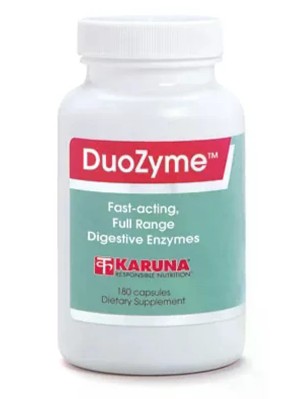
DuoZyme provides broad acid, enzyme, and bile support with substantial disclosed amounts. Missing activity units and source details reduce potency confidence, while the high serving cost limits value.
DuoZyme provides broad acid, enzyme, and bile support with substantial disclosed amounts. Missing activity units and source details reduce potency confidence, while the high serving cost limits value.
Each serving combines 300 mg of betaine hydrochloride, 300 mg of glutamic acid hydrochloride, 100 mg of papain, 40 mg of pepsin, 300 mg of pancreatin 6x, and 120 mg of ox bile extract. The ingredients address complementary digestive steps rather than relying on one enzyme.
Papain reaches a substantial listed amount, while acid support and ox bile make the formula relevant to protein and fat digestion. The label does not give activity units for papain, pepsin, or pancreatin, so weight alone cannot confirm functional potency.
Most ingredient amounts are clearly disclosed, but papain source and purification details are absent and the glutamic acid form does not include an L-prefix. The 90-serving capsule supply is expensive, making the product a better fit for someone who intentionally wants the full combination.
thumb_upPros
Covers several complementary digestive steps
Papain, pepsin, pancreatin, and ox bile amounts are disclosed
Provides substantial betaine and glutamic acid hydrochloride amounts
Offers 90 servings per container
thumb_downCons
Enzyme activity units are not supplied.
Papain source and purification details are absent.
The glutamic acid label does not confirm the L-isomer.
Serving value is weak compared with simpler enzyme products.
warningWarnings
Betaine hydrochloride and glutamic acid hydrochloride add acidity and may aggravate upper-digestive irritation in sensitive users.
Ox bile can cause loose stools or digestive discomfort if the serving is not well tolerated.
Papain may be unsuitable for people with papaya sensitivity, and its source is not identified on the supplied label.
scienceNutrient quality
83
Highest impact
Acid support, proteolytic enzymes, pancreatin, and ox bile cover several digestive steps with substantial weights. Glutamic acid hydrochloride fits the purpose, but missing enzyme activity and source details limit potency confidence.
scienceIngredient transparency
75
High impact
Principal active weights are disclosed and no proprietary blend hides their doses. Missing enzyme activity, an incomplete minimum-provision entry, full use directions, and complete other ingredients reduce clarity.
thumb_upCustomer satisfaction
60
Moderate impact
The supplied average rating is strong, but the small review sample limits confidence. No detailed comments are provided to assess repeated complaints or whether experiences match the intended use.
workspace_premiumValue for money
56
Moderate impact
Substantial digestive ingredients provide real formula value, but recurring cost is high. Missing activity units and source details weaken comparison with less expensive enzyme products.
A-
Goal FitB-
Strength of SupportA-
CoverageA
Formula Quality
Papain · 100 mg
The enzyme and acid-support formula is closely aligned with food breakdown and fat digestion. Papain, pepsin, pancreatin, betaine hydrochloride, and ox bile cover complementary digestive steps.
Most ingredient amounts are disclosed and substantial enough to be meaningful. Missing enzyme activity units and limited source details reduce confidence in potency consistency.
scienceStudy evidence
SupportiveMixedNo effectAdverse
Papain Adverse star star star_border star_border star_border 2 studies
B-
Active Ingredient Quality & BioavailabilityA+
Dose, Safety & Label TransparencyD-
Value
Glutamic Acid Hydrochloride is a functionally appropriate form in this digestive-enzyme formula. The label does not include the L-prefix, although the 300 mg amount is substantial and clear. A moderately high serving cost results in middling value.
D+
Active Ingredient Quality & BioavailabilityA+
Dose, Safety & Label TransparencyF
Value
The label reports papain only by weight, so biological activity cannot be verified in standardized units. The source and purification details are not identified, limiting confidence in enzyme consistency. The clearly disclosed 100 mg dose reaches the range used for stronger systemic or joint-support purposes, and the high serving cost weakens value without activity-standardized papain or an advanced delivery feature.
<p>Glutamic Acid 500 mg offers a stronger ingredient-led alternative to DuoZyme through 500 mg of L-glutamic acid in a single-active formula. The much larger glutamic-acid dose strengthens that collection, but it does not supply digestive enzymes.</p>
<p>Chewable Papaya Enzyme with Chlorophyll offers a stronger ingredient-led alternative to DuoZyme through 45 mg of papain with protease, amylase, papaya, and chlorophyll. The simple chewable improves papain quality and value, but glutamic acid and broader enzyme activity are absent.</p>
<p>Advanced Digestive Enzymes offers a stronger ingredient-led alternative to DuoZyme through 480 mg each of betaine hydrochloride and glutamic acid hydrochloride with pancreatin, bile, and pepsin. The substantial acid-support amounts and coherent digestive blend improve depth, while animal-derived ingredients and missing activity units limit suitability.</p>
<p>Chewable Papaya Enzymes lowers serving cost while providing 100 mg of papain, 20 mg each of bromelain and protease, plus lipase, cellulase, and amylase. The broad, inexpensive enzyme mix improves papain exposure, but activity units are not supplied.</p>
<p>Calcium Citrate 250 mg lowers serving cost while providing 50 mg of glutamic acid hydrochloride alongside calcium citrate. The very low cost improves the glutamic-acid amount, but the product is not a full digestive-enzyme substitute.</p>
<p>Chewable Original Papaya Enzyme lowers serving cost while providing 45 mg of papain with amylase and protease. The economical chewable improves papain exposure, though activity units and glutamic acid are absent.</p>
<p>Digestive Enzymes balances formula quality and cost with pancreatin, ox bile, papain, bromelain, cellulase, diastase, and betaine hydrochloride. The broad formula has strong quality-to-cost evidence, but glutamic acid is absent and enzyme activity units are missing.</p>
<p>HCl with Pepsin balances formula quality and cost with 250 mg of betaine hydrochloride, 100 mg of glutamic acid hydrochloride, 150 mg of pepsin, and papaya. The focused acid-and-pepsin approach offers good value, though it may not suit active reflux or peptic ulcers.</p>
<p>Natural Tropical Papaya balances formula quality and cost with papain, protease, amylase, and papaya. The plant-based chewable balances cost and enzyme breadth, but activity units and glutamic acid are not disclosed.</p>
flagReport alternatives
schoolSources
Published studies used for the product analysis and the top-ranked studies for each ingredient and goal.