Product Image

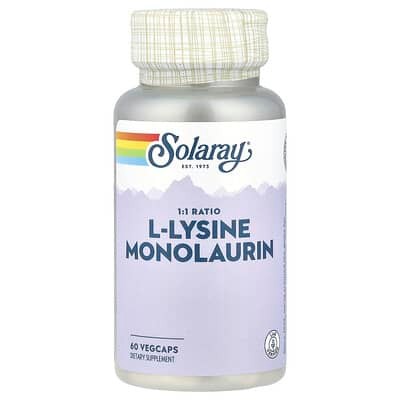
L-Lysine Monolaurin 1:1 Ratio

Solaray
4.9
★ ★ ★ ★ ★
(14851 ratings)
Monolaurin 500 mg
Lysine 500 mg
Product Image
Score83
A focused lysine-and-monolaurin combination with practical disclosed amounts. The duplicated monolaurin presentation should be verified to understand the true total.
How scoring works
Quantity:60 VegCap(s) • (30 servings)
Goals:
Immunity
Hair Health

Score 83

A focused lysine-and-monolaurin combination with practical disclosed amounts. The duplicated monolaurin presentation should be verified to understand the true total.
How scoring works
$13.99($0.46 per serving)
Vitacost
$ 13.99
Pure Formulas
$ 13.99
iHerb
$ 13.99
Amazon
$ 13.99
Report prices

Analysis

Coconut-derived glycerol monolaurate supplies a meaningful 500 mg monolaurin amount. The named source and form make that side of the formula relatively easy to assess.

Lysine hydrochloride contributes another 500 mg, which is useful but not especially concentrated for standalone lysine use. Pairing the two ingredients keeps the design narrow rather than padding it with unrelated additions.

Two capsules provide the full serving and the active amounts are visible. The duplicated monolaurin entries make it unclear whether the label is describing one 500 mg amount in two ways or separate quantities, so the physical label should settle that point.

Who is it for
  • Adults seeking a simple lysine and monolaurin combination
  • People who prefer vegetarian capsules
  • Users who want a narrow two-active formula
Best for
  • Combined lysine and monolaurin intake
  • Simple capsule routines
  • Users avoiding crowded blends

Pros

  • Provides 500 mg lysine hydrochloride
  • Names coconut-derived glycerol monolaurate
  • Keeps the formula focused
  • Uses a practical two-capsule serving

Cons

  • Lysine amount is modest for standalone use
  • Monolaurin appears twice in the supplied data
  • No premium purity or sourcing claim is provided
  • Not a broad foundational wellness formula

Warnings

  • The supplied data lists monolaurin twice at 500 mg, so verify the physical label before assuming the serving provides either 500 mg or 1,000 mg total.
  • Lysine can increase calcium absorption, which may matter for people already using high-dose calcium supplements or being monitored for high calcium levels.
  • Monolaurin can cause digestive discomfort in some users; starting with the labeled serving only helps reveal individual tolerance.

Nutrient quality

90 Highest impact

The two named actives use recognizable forms and reach useful supplemental amounts. The narrow formula is coherent and avoids low-value additions.

.
Ingredient transparency

76 High impact

The active forms and amounts are disclosed without a proprietary blend. Duplicate monolaurin lines, missing other ingredients, and incomplete use directions leave some label ambiguity.

.

Customer satisfaction

74 High impact

The supplied satisfaction average is strong and has very large supporting volume. No specific experience details are provided to assess repeated complaints or alignment with the intended use.

.

Value for money

92 Highest impact

Useful amounts of two focused actives provide strong practical value at an accessible serving cost. Missing premium purity evidence is the main limitation rather than formula padding.

.

Report analysis

Goals

Immunity
Impact
High effect
D Goal FitB+ Strength of SupportD+ CoverageA Formula Quality
Monolaurin · 500 mg

Lysine and coconut-derived glycerol monolaurate form a clearly disclosed targeted pair. Both amounts are meaningful for their intended use, but the combination remains narrow for general wellness.

The formula does not address common vitamin, mineral, or fatty-acid gaps. Evidence for lysine biology is established, while broad human evidence for supplemental monolaurin remains limited.

Study evidence
Lysine Supportive 2 studies
Monolaurin Not classified 1 study
Hair Health
Impact
Moderate effect
C- Goal FitB Strength of SupportD- CoverageD- Formula Quality
Lysine · 500 mg

Lysine may support protein synthesis and iron use, but only half a gram is provided and monolaurin is not a core hair ingredient. The combination is therefore less useful for hair than a full-dose standalone lysine product.

The lysine hydrochloride amount is clear, and the monolaurin source is also disclosed. Hair pathway coverage remains narrow, with no collagen, iron, zinc, biotin, or vitamin D.

Study evidence
Lysine Supportive 1 study

Ingredients

IngredientAmount per serving
L-Lysine Hydrochloride
500 mg
Monolaurin (Coconut, Glycerol Monolaurate)
500 mg
Adults 18–50
Report overview
A+ Active Ingredient Quality & BioavailabilityB+ Dose, Safety & Label TransparencyC Value

Coconut-derived glycerol monolaurate provides a strong standard amount with clear form and dose disclosure. Two capsules are needed for the full serving, which remains practical for regular use. Added lysine supports the broader formula, although monolaurin cost efficiency alone is only moderate.

Lysine · 500 mg OverallScore72
B- Active Ingredient Quality & BioavailabilityA Dose, Safety & Label TransparencyF Value

The hydrochloride form delivers a useful 500 mg amount, paired with monolaurin in a two-capsule serving. The active form and dose suit the collection, but no enhanced purity grade or sourcing claim is stated. Added monolaurin broadens the formula, while lysine value is weak compared with single-ingredient options.

Loading alternative details
Report alternatives

Sources

Published studies used for the product analysis and the top-ranked studies for each ingredient and goal.

  1. Causes of hair loss and the developments in hair rejuvenation.
    Rushton DH; Norris MJ; Dover R; Busuttil N · International journal of cosmetic science · 2010
    Narrative reviewHair Health forLysine
  2. Lysine-fortified wheat flour improves the nutritional and immunological status of wheat-eating families in northern China.
    Zhao W; Zhai F; Zhang D; An Y; Liu Y; He Y; Ge K; Scrimshaw NS · Food and nutrition bulletin · 2004
    Clinical trial264 participantsImmunity forLysine
  3. Success of L-lysine therapy in frequently recurrent herpes simplex infection. Treatment and prophylaxis
    R S Griffith, D E Walsh, K H Myrmel, R W Thompson, A Behforooz · Dermatologica · 1987
    Non-randomized trial52 participantsImmunity forLysine
  4. Reduction in Staphylococcus aureus growth and exotoxin production and in vaginal interleukin 8 levels due to glycerol monolaurate in tampons
    Kristi L Strandberg, Marnie L Peterson, Matthew M Schaefers, Laura C Case, Melinda C Pack, David J Chase, Patrick M Schlievert · Clinical infectious diseases : an official publication of the Infectious Diseases Society of America · 2009
    Randomized trial225 participantsImmunity forMonolaurin