Product Image

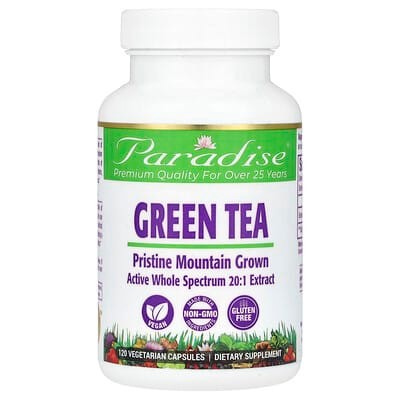
Green Tea

Paradise
4.6
★ ★ ★ ★ ★
(232 ratings)
Green Tea 250 mg
Product Image
Score73
A simple, economical green tea capsule lacks the active-marker and caffeine details needed for dependable dosing.
How scoring works
Quantity:120 Capsule(s) • (120 servings)
Goals:
Anti-Inflammatory Support
Anti-Aging
Cognitive Support

Score 73

A simple, economical green tea capsule lacks the active-marker and caffeine details needed for dependable dosing.
How scoring works
$13.49($0.11 per serving)
iHerb
$ 13.49
Amazon
$ 14.99
Report prices

Analysis

The capsule supplies 250 mg of green tea leaf extract without unrelated active ingredients. That focused design is easy to understand but does not reveal the catechin profile.

A 120-serving bottle supports convenient long-term use at low recurring cost. No standardized marker or enhanced-absorption system is shown.

It suits users comfortable with a basic, unstandardized green tea extract. People seeking predictable EGCG intake should choose a fully quantified product.

Who is it for
  • Adults seeking a basic green tea extract
  • Long-term users prioritizing low cost
  • People comfortable with unstandardized botanicals
Best for
  • Simple daily green tea use
  • One-capsule convenience
  • Large-count value

Pros

  • Single active ingredient
  • Provides 250 mg green tea extract
  • 120-serving supply
  • Low recurring cost

Cons

  • EGCG is not disclosed
  • Caffeine is not stated
  • No polyphenol standardization
  • No absorption support

Warnings

  • Concentrated green tea extract may cause nausea or stomach discomfort, especially when taken without food.
  • Green tea catechins can reduce iron absorption; separate the capsule from iron supplements or iron-rich meals when iron status is a concern.
  • Caffeine content is not stated, so stimulant-sensitive users should avoid taking it late in the day.

Nutrient quality

73 High impact

The green-tea ingredient is clear but lacks all active-marker standardization. The amount may contribute, though effective catechin exposure cannot be verified.

.
Ingredient transparency

72 High impact

The total extract amount is shown without a hidden blend. Marker yields, caffeine, directions, and inactive ingredients are missing.

.

Customer satisfaction

65 High impact

The supplied aggregate rating indicates favorable customer satisfaction. Specific comments are unavailable, so complaint patterns and intended-use fit cannot be verified.

.

Value for money

81 Highest impact

Low serving cost and a simple formula support basic value. Missing potency data prevents a reliable active-value comparison.

.

Report analysis

Goals

Anti-Inflammatory Support
Impact
Moderate effect
B Goal FitD- Strength of SupportF CoverageA+ Formula Quality
Green Tea · 250 mg

Green tea extract has a relevant role in oxidative stress and inflammatory signaling. The 250 mg extract weight may be useful, but undisclosed EGCG strength prevents knowing the active catechin dose.

The single-ingredient formula is streamlined and avoids unnecessary overlap. Undisclosed caffeine content makes stimulant exposure and suitability for sensitive users difficult to predict.

Study evidence
Green Tea Mixed 16 studies
Anti-Aging
Impact
Moderate effect
C Goal FitF Strength of SupportD CoverageA- Formula Quality
Green Tea · 250 mg

Green tea extract may support antioxidant and metabolic pathways relevant to healthy aging. The label does not state its EGCG, polyphenol, or caffeine content, so the active strength and stimulant exposure cannot be judged.

The total extract amount is clear, but no standardization or absorption support is disclosed. The simple formula avoids padding, yet its uncertain potency sharply limits confidence in a meaningful anti-aging contribution.

Study evidence
Green Tea Supportive 9 studies
Cognitive Support
Impact
Moderate effect
D+ Goal FitF Strength of SupportD- CoverageA+ Formula Quality
Green Tea · 250 mg

Green tea can support alertness through caffeine and calm focus through L-Theanine. Neither active is quantified here, so the expected cognitive effect is uncertain.

The single-extract capsule is simple, but it lacks catechin standardization and stimulant disclosure. Concentrated green tea extract can rarely affect the liver, especially when taken on an empty stomach, so following label directions with food is prudent if allowed by the label.

Study evidence
Green Tea Supportive 32 studies

Ingredients

IngredientAmount per serving
Green Tea leaf extract
250 mg
Gluten Free Adults 18–50 Vegan No Allergies Vegetarian
Report overview
Green Tea · 250 mg OverallScore8
F Active Ingredient Quality & BioavailabilityF Dose, Safety & Label TransparencyF Value

The formula supplies a straightforward green tea extract but gives no active-marker standardization. EGCG dose and caffeine content are both undisclosed. The low serving cost cannot confirm value without a measurable active dose.

Loading alternative details
Report alternatives

Sources

Published studies used for the product analysis and the top-ranked studies for each ingredient and goal.

  1. Green tea and coffee intake and risk of cognitive decline in older adults: the National Institute for Longevity Sciences, Longitudinal Study of Aging.
    Shirai Y; Kuriki K; Otsuka R; Kato Y; Nishita Y; Tange C; Tomida M; Imai T; Ando F; Shimokata H · Public health nutrition · 2021
    Cohort study1,305 participantsAnti-Aging forGreen Tea
  2. Associations of green tea, coffee, and soft drink consumption with longitudinal changes in leukocyte telomere length.
    Sohn I; Shin C; Baik I · Scientific reports · 2023
    Cohort study1,952 participantsAnti-Aging forGreen Tea
  3. Can teatime increase one's lifetime?
    Nakachi K; Eguchi H; Imai K · Ageing research reviews · 2003
    Cohort studyAnti-Aging forGreen Tea
  4. Influences of tea consumption on self-rated health and life satisfaction among older adults: Evidence from the CLHLS.
    Zou M; Sun C; Yang M; Li C; Wang S; Zheng D; Wang J; Yu L; Sun L; Wang Y; Chen H; Zeng Y · PsyCh journal · 2025
    Cohort study78,345 participantsAnti-Aging forGreen Tea
  5. Double-blinded, placebo-controlled trial of green tea extracts in the clinical and histologic appearance of photoaging skin.
    Chiu AE; Chan JL; Kern DG; Kohler S; Rehmus WE; Kimball AB · Dermatologic surgery : official publication for American Society for Dermatologic Surgery [et al.] · 2005
    Randomized trial40 participantsAnti-Aging forGreen Tea
  6. The effects of green tea on acne vulgaris: A systematic review and meta-analysis of randomized clinical trials.
    Kim S; Park TH; Kim WI; Park S; Kim JH; Cho MK · Phytotherapy research : PTR · 2021
    Meta-analysis247 participants5 studies pooledAnti-Inflammatory Support forGreen Tea
  7. Green Tea Catechin Association with Ultraviolet Radiation-Induced Erythema: A Systematic Review and Meta-Analysis.
    Kapoor MP; Sugita M; Fukuzawa Y; Timm D; Ozeki M; Okubo T · Molecules (Basel, Switzerland) · 2021
    Meta-analysis100 participants6 studies pooledAnti-Inflammatory Support forGreen Tea
  8. Efficacy of (-)-epigallocatechin gallate delivered by a new-type scaler tip during scaling and root planing on chronic periodontitis: a split-mouth, randomized clinical trial.
    Wang Y; Zeng J; Yuan Q; Luan Q · BMC oral health · 2021
    Randomized trial20 participantsAnti-Inflammatory Support forGreen Tea
  9. Camellia Sinensis Mouthwashes in Oral Care: a Systematic Review.
    Tafazoli A; Tafazoli Moghadam E · Journal of dentistry (Shiraz, Iran) · 2020
    Systematic review69 studies pooledAnti-Inflammatory Support forGreen Tea
  10. Skin photoprotection by green tea: antioxidant and immunomodulatory effects.
    Katiyar SK · Current drug targets. Immune, endocrine and metabolic disorders · 2004
    Narrative reviewAnti-Inflammatory Support forGreen Tea
  11. Safety and efficacy of cognitive training plus epigallocatechin-3-gallate in young adults with Down's syndrome (TESDAD): a double-blind, randomised, placebo-controlled, phase 2 trial.
    de la Torre R; de Sola S; Hernandez G; Farré M; Pujol J; Rodriguez J; Espadaler JM; Langohr K; Cuenca-Royo A; Principe A; Xicota L; Janel N; Catuara-Solarz S; Sanchez-Benavides G; Bléhaut H; Dueñas-Espín I; Del Hoyo L; Benejam B; Blanco-Hinojo L; Videla S; Fitó M; Delabar JM; Dierssen M; TESDAD study group · The Lancet. Neurology · 2017
    Randomized trial87 participantsCognitive Support forGreen Tea
  12. Association between tea consumption and risk of cognitive disorders: A dose-response meta-analysis of observational studies.
    Liu X; Du X; Han G; Gao W · Oncotarget · 2018
    Meta-analysis48,435 participants17 studies pooledCognitive Support forGreen Tea
  13. Investigating the Impact of Tea Consumption on Cognitive Function and Exploring Tea-Genetic Interactions in Older Adults Aged 65-105 Years: Findings from the 2002-2018 CLHLS Data.
    Yu L; Yang M; Ye KX; Li C; Zou M; Wang J; Yuan X; Zheng D; Sun C; Zhang Y; Feng Q; Maier AB; Sun L; Feng L; Wang Y; Chen H; Zeng Y · The journal of prevention of Alzheimer's disease · 2024
    Cohort study76,270 participantsCognitive Support forGreen Tea
  14. Consumption of green tea, but not black tea or coffee, is associated with reduced risk of cognitive decline.
    Noguchi-Shinohara M; Yuki S; Dohmoto C; Ikeda Y; Samuraki M; Iwasa K; Yokogawa M; Asai K; Komai K; Nakamura H; Yamada M · PloS one · 2014
    Cohort study490 participantsCognitive Support forGreen Tea
  15. Green Tea Consumption and the Risk of Incident Dementia in Elderly Japanese: The Ohsaki Cohort 2006 Study.
    Tomata Y; Sugiyama K; Kaiho Y; Honkura K; Watanabe T; Zhang S; Sugawara Y; Tsuji I · The American journal of geriatric psychiatry : official journal of the American Association for Geriatric Psychiatry · 2018
    Cohort study13,645 participantsCognitive Support forGreen Tea