Product Image

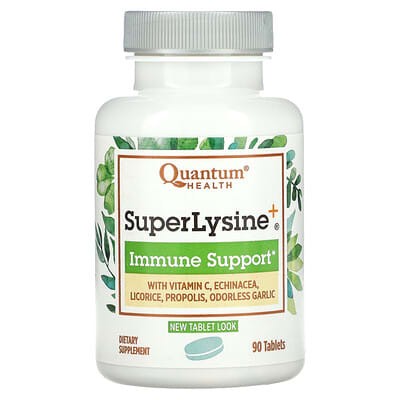
Super Lysine+ Immune Support

Quantum Health
4.8
★ ★ ★ ★ ★
(5526 ratings)
Lysine 1500 mg
Propolis 25 mg
Product Image
Score80
A strong lysine amount and useful companion botanicals provide good immune-support value. Tablet burden and ingredient-specific safety considerations require attention.
How scoring works
Quantity:90 Tablet(s) • (30 servings)
Goals:
Immunity
Hair Health

Score 80

A strong lysine amount and useful companion botanicals provide good immune-support value. Tablet burden and ingredient-specific safety considerations require attention.
How scoring works
$12.63($0.42 per serving)
Pure Formulas
$ 13.28
Vitacost
$ 12.63
iHerb
$ 13.25
Vitacost
$ 12.63
Amazon
$ 13.25
Report prices

Analysis

Three tablets provide 1.5 g lysine hydrochloride, 200 mg garlic extract, 100 mg echinacea, 25 mg propolis extract, 15 mg licorice, and 100 mg vitamin C. Lysine reaches a meaningful amount and clearly anchors the formula.

The companion ingredients broaden immune-related support, but propolis lacks geographic source and active-marker standardization. The product is stronger for lysine delivery than for hair support or dedicated propolis use.

Thirty servings and three tablets per dose create a short, less convenient supply. The serving cost remains reasonable for the lysine amount and multiple botanicals.

Who is it for
  • Adults seeking a lysine immune-support tablets
  • Users whose needs match the disclosed ingredient amounts
  • People who can screen ingredient-specific medication and tolerance concerns
Best for
  • Comparing form, dose, and practical value
  • Goal-aligned supplement selection
  • Users who prefer a lysine immune-support tablets

Pros

  • Provides 1.5 g lysine
  • Includes vitamin C and garlic
  • Adds echinacea and propolis
  • Good value for the lysine amount

Cons

  • Requires three tablets
  • Only 30 servings
  • Propolis amount is small
  • No propolis active-marker standardization
  • Limited hair-support relevance

Warnings

  • Propolis can trigger reactions in people allergic to bee products
  • Garlic may increase bleeding tendency with anticoagulant or antiplatelet medicines
  • Licorice may raise blood pressure or lower potassium, especially with prolonged use or relevant medicines
  • Echinacea may trigger reactions in people with ragweed-family allergies

Nutrient quality

80 Highest impact

Lysine hydrochloride receives a substantial amount and the botanical extracts have clear ratios. Propolis and licorice are small, while their allergy and interaction risks still matter.

Ingredient transparency

80 Highest impact

Listed active ingredients have specific weights and no proprietary blend hides their doses. Complete use directions and a full other-ingredients list are not included in the supplied facts.

Customer satisfaction

73 High impact

The supplied average rating is strong, and review volume provides a stable broad signal. No detailed comments are provided to assess repeated complaints or whether experiences match the intended use.

Value for money

84 Highest impact

Meaningful core dosing and favorable recurring cost support good practical value. Incomplete form, activity, or use details remain the main value trade-off.

Report analysis

Goals

Immunity
Impact
High effect
C+ Goal FitB- Strength of SupportB CoverageC+ Formula Quality
Vitamin C · 100 mgPropolis · 25 mg

L-lysine, vitamin C, garlic, echinacea, propolis, and licorice create a targeted formula with amino-acid and botanical immune support. Lysine is well dosed, while vitamin C and several smaller extracts provide secondary contributions.

Evidence is mixed across the botanical ingredients, and the modest propolis and licorice amounts limit depth. Propolis can trigger reactions in people allergic to bee products, garlic may add to anticoagulant effects, and licorice may raise blood pressure or lower potassium.

Study evidence
Lysine Supportive 2 studies
Propolis Supportive 6 studies
Vitamin C Supportive 53 studies
Hair Health
Impact
High effect
C+ Goal FitA- Strength of SupportC CoverageC- Formula Quality
Lysine · 1500 mgVitamin C · 100 mg

L-lysine may support collagen formation and iron use, making it conditionally relevant to shedding. Evidence is most useful when protein or iron status is inadequate.

Lysine reaches a meaningful amount and vitamin C supports collagen-related use. Garlic, echinacea, propolis, and licorice follow an immune theme rather than a hair strategy.

Study evidence
Lysine Supportive 1 study
Vitamin C Mixed 5 studies

Ingredients

IngredientAmount per serving
Vitamin C (Ascorbic Acid)
100 mg
Calcium (Calcium Stearate, Dicalcium Phosphate)
29 mg
L-Lysine (L-Lysine Hydrochloride)
1500 mg
Garlic Bulb (Allium Sativum) Plant Extract 3:1 (Allicin)
200 mg
Echinacea Whole Plant (Echinacea Purpurea) Plant Extract 4:1
100 mg
Propolis Plant Extract 2:1
25 mg
Licorice Root (Glycyrrhiza Glabra) Plant Extract 4:1
15 mg
Adults 18–50 Dairy Free Sugar Free
Report overview
B- Active Ingredient Quality & BioavailabilityB Dose, Safety & Label TransparencyA+ Value

The 1,500 mg L-lysine hydrochloride serving reaches the upper end of the preferred dose range. Three tablets reduce convenience, while calcium stearate keeps the additive profile acceptable rather than minimal. Vitamin C and concentrated botanical extracts add useful immune-focused context and support good value for the active dose.

Propolis · 25 mg OverallScore40
F Active Ingredient Quality & BioavailabilityD+ Dose, Safety & Label TransparencyF Value

The disclosed propolis uses a useful concentrated extract ratio, but its geographic source and active-marker standardization are missing. Its small propolis amount and high cost per active dose limit its fit as a dedicated propolis supplement. Propolis can trigger reactions in people allergic to bee products, while garlic may increase bleeding risk with anticoagulants and licorice may raise blood pressure or lower potassium.

Loading alternative details
Report alternatives

Sources

Published studies used for the product analysis and the top-ranked studies for each ingredient and goal.

  1. Propolis increases Foxp3 expression and lymphocyte proliferation in HIV-infected people: A randomized, double blind, parallel-group and placebo-controlled study.
    Conte FL; Tasca KI; Santiago KB; de Oliveira Cardoso E; Romagnoli GG; de Assis Golim M; Braz AMM; Berretta AA; do Rosário de Souza L; Sforcin JM · Biomedicine & pharmacotherapy = Biomedecine & pharmacotherapie · 2021
    Randomized trial40 participantsImmunity forPropolis
  2. Propolis does not significantly modulate immune function in an older population: A preliminary study.
    Pu L; Wang Y; Pang W; Wei J; Wu J; Guo C; Weina Gao · Heliyon · 2025
    Randomized trial62 participantsImmunity forPropolis
  3. Lysine-fortified wheat flour improves the nutritional and immunological status of wheat-eating families in northern China.
    Zhao W; Zhai F; Zhang D; An Y; Liu Y; He Y; Ge K; Scrimshaw NS · Food and nutrition bulletin · 2004
    Clinical trial264 participantsImmunity forLysine
  4. Causes of hair loss and the developments in hair rejuvenation.
    Rushton DH; Norris MJ; Dover R; Busuttil N · International journal of cosmetic science · 2010
    Narrative reviewHair Health forLysine
  5. Management of hair loss associated with endocrine therapy in patients with breast cancer: an overview.
    Karatas F; Sahin S; Sever AR; Altundag K · SpringerPlus · 2016
    Narrative reviewHair Health forVitamin C
  6. Elucidating causal relationships of diet-derived circulating antioxidants and the risk of non-scarring alopecia: A Mendelian randomization study.
    Ba Y; Shen L; Peng X; Zhang Y; Wang J · Medicine · 2024
    Methods validation study201,019 participantsHair Health forVitamin C
  7. Alterations of plasma antioxidants and mitochondrial DNA mutation in hair follicles of smokers.
    Liu CS; Chen HW; Lii CK; Tsai CS; Kuo CL; Wei YH · Environmental and molecular mutagenesis · 2002
    Observational studyHair Health forVitamin C
  8. Removal of synthetic hair dye using formamidine sulfinic acid and other sulfinate precursors.
    Hawkes JA; Lewis DM; Mama J; Murray J · International journal of cosmetic science · 2026
    Methods validation studyHair Health forVitamin C
  9. A Zinc Sulphate-Resistant Acrodermatitis Enteropathica Patient with a Novel Mutation in SLC39A4 Gene.
    Kilic M; Taskesen M; Coskun T; Gürakan F; Tokatli A; Sivri HS; Dursun A; Schmitt S; Küry S · JIMD reports · 2013
    Case reportHair Health forVitamin C
  10. Success of L-lysine therapy in frequently recurrent herpes simplex infection. Treatment and prophylaxis
    R S Griffith, D E Walsh, K H Myrmel, R W Thompson, A Behforooz · Dermatologica · 1987
    Non-randomized trial52 participantsImmunity forLysine
  11. Immune Responses in Broiler Chicks Fed Propolis Extraction Residue-supplemented Diets.
    Eyng C; Murakami AE; Santos TC; Silveira TG; Pedroso RB; Lourenço DA · Asian-Australasian journal of animal sciences · 2015
    Randomized trialImmunity forPropolis
  12. Integrative Therapies in Wound Healing in Small Animals: An Approach Beyond Traditional Medicine.
    Santos JKVRS; Costa EDS; Fernandes CCL; Cortez AA; Fonsêca ADV; Guedes RFM; Araújo PRM · Veterinary sciences · 2026
    Narrative reviewImmunity forPropolis
  13. A standardized polyphenol mixture extracted from poplar-type propolis for remission of symptoms of uncomplicated upper respiratory tract infection (URTI): A monocentric, randomized, double-blind, placebo-controlled clinical trial.
    Esposito C; Garzarella EU; Bocchino B; D'Avino M; Caruso G; Buonomo AR; Sacchi R; Galeotti F; Tenore GC; Zaccaria V; Daglia M · Phytomedicine : international journal of phytotherapy and phytopharmacology · 2020
    Randomized trial122 participantsImmunity forPropolis
  14. Vitamin C and contribution to the normal function of the immune system: evaluation of a health claim pursuant to Article 14 of Regulation (EC) No 1924/2006.
    EFSA Panel on Dietetic Products, Nutrition and Allergies (NDA) · EFSA journal. European Food Safety Authority · 2026
    Guideline / consensusImmunity forVitamin C
  15. Therapeutic effects of high-dose vitamin C supplementation in patients with COVID-19: a meta-analysis.
    Sun L; Zhao JH; Fan WY; Feng B; Liu WW; Chen RQ; Ban C; Dang AG; Wang M; Luo KT; Zhou GY; Yu FF; Ba Y · Nutrition reviews · 2024
    Meta-analysis2,334 participants14 studies pooledImmunity forVitamin C
  16. Effect of micronutrient supplements on influenza and other respiratory tract infections among adults: a systematic review and meta-analysis.
    Abioye AI; Bromage S; Fawzi W · BMJ global health · 2021
    Meta-analysisImmunity forVitamin C
  17. New evidence for antioxidant properties of vitamin C.
    Vojdani A; Bazargan M; Vojdani E; Wright J · Cancer detection and prevention · 2001
    Randomized trial20 participantsImmunity forVitamin C
  18. Enhanced Vitamin C Delivery: A Systematic Literature Review Assessing the Efficacy and Safety of Alternative Supplement Forms in Healthy Adults.
    Calder PC; Kreider RB; McKay DL · Nutrients · 2025
    Systematic review13 studies pooledImmunity forVitamin C