
Nutrient quality
The long-supply single-herb design is focused and avoids unrelated filler. Absent standardization makes the large raw amount difficult to judge for either effectiveness or safety.
.
 Vitacost Vitacost | $ 23.24 | |
 iHerb iHerb | $ 23.24 | |
 Amazon Amazon | $ 23.24 |
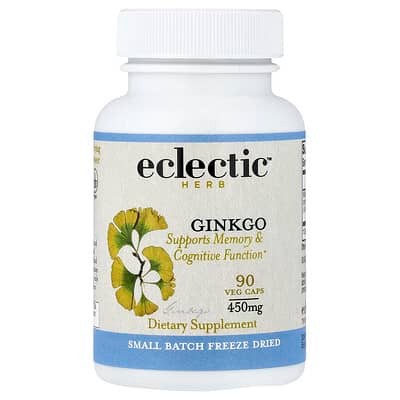
The capsule provides 450 mg freeze-dried ginkgo leaf rather than a clearly standardized extract. Whole leaf preserves the simple botanical format but does not guarantee a predictable active-marker yield.
Ginkgo has a plausible circulation-related role for cognition, memory, and focus in selected users. Vision relevance remains narrow because the formula lacks macular carotenoids, retinal fats, and antioxidant minerals.
No flavone-glycoside percentage, terpene-lactone percentage, or ginkgolic-acid purity limit is supplied. A large raw-leaf number should not be treated as equivalent to a smaller standardized extract.
The long-supply single-herb design is focused and avoids unrelated filler. Absent standardization makes the large raw amount difficult to judge for either effectiveness or safety.
.The whole-herb amount and preparation are disclosed without a hidden blend. Standardization, daily-use directions, and non-active ingredients remain unavailable.
.The available rating is favorable and the sample is moderate. Detailed feedback was not supplied, so repeated complaints and alignment with the intended use remain uncertain.
.The long supply offers moderate raw-herb value. Missing standardization prevents a reliable comparison with effective ginkgo extracts.
.
Natural astaxanthin provides targeted retinal antioxidant support and may help eye strain linked to prolonged screen use. Human evidence is promising for visual fatigue but less comprehensive than multi-nutrient macular formulas.
The algae source and substantial amount are clearly disclosed in a fat-containing softgel. The focused formula offers strong antioxidant depth but does not cover macular pigments, minerals, or omega fatty acids.

Ginkgo is directly relevant to cerebral circulation and cognitive performance. The full freeze-dried leaf amount is clearly stated.
Missing flavone-glycoside and terpene-lactone standardization makes the effective dose impossible to confirm. Ginkgo may increase bleeding risk when combined with anticoagulant or antiplatelet medicines.

Ginkgo directly targets cerebral circulation, a relevant pathway for memory and processing. The 450 mg freeze-dried amount is clear, but it is not comparable to a standardized extract without active-marker data.
Missing flavone-glycoside, terpene-lactone, and ginkgolic-acid details leave potency and purity uncertain. Ginkgo may increase bleeding risk when combined with anticoagulant or antiplatelet medicines.

Ginkgo has a plausible circulation and cognitive mechanism, but evidence for improving focus in healthy adults is inconsistent. Freeze-dried leaf is not equivalent to a standardized clinical extract, so the large stated amount is difficult to interpret.
The one-ingredient design is simple and the full leaf amount is disclosed. Ginkgo may raise bleeding risk when combined with anticoagulant or antiplatelet medicines.

Ginkgo may support some aspects of cognition, but evidence for better productivity in healthy users is inconsistent. A freeze-dried 450 mg ingredient is not clearly comparable with standardized extracts used in many trials.
The amount is disclosed, while flavonol and terpene percentages are not. Ginkgo may increase bleeding risk with anticoagulant or antiplatelet medicines.
| Ingredient | Amount per serving |
|---|---|
Ginkgo biloba, Freeze-Dried (Ginkgo Flavonols) | 450 mg |
The freeze-dried ginkgo does not disclose a standardized extract, so its active-marker strength and purity are uncertain. The full ginkgo amount is listed, but the serving is above common standardized-extract dosing while not showing that it delivers comparable active compounds. Value is difficult to judge because the low serving cost does not establish an effective standardized dose, and ginkgo can raise bleeding risk with anticoagulant or antiplatelet medicines.
Published studies used for the product analysis and the top-ranked studies for each ingredient and goal.