Nutrient quality
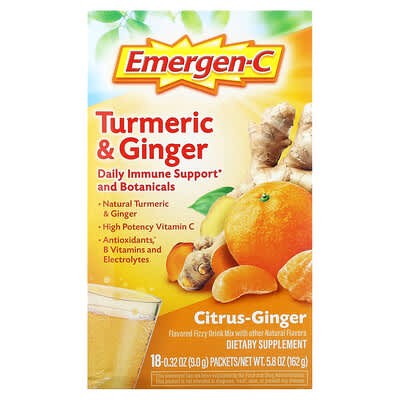
The drink supplies substantial vitamin C and moderate potassium with smaller botanicals. Weak turmeric potency, modest ginger, and a crowded nutrient list reduce intended-use depth.
.
 iHerb iHerb | $ 15.42 | |
 Vitacost Vitacost | $ 16.53 |
Vitamin C is the main active, supported by B vitamins, magnesium, zinc, and potassium. The packet format may be convenient for users who prefer a drink to tablets or capsules.
Ginger provides 150 mg and turmeric 100 mg, but neither entry includes an extract ratio or active-marker standardization. Those amounts are unlikely to match the botanical emphasis suggested by the product name.
The formula offers a broad set of basic nutrients with moderate carbohydrates and sodium. It may fit occasional use, though the label contains duplicate source entries that make several mineral totals harder to interpret.
The drink supplies substantial vitamin C and moderate potassium with smaller botanicals. Weak turmeric potency, modest ginger, and a crowded nutrient list reduce intended-use depth.
.Most listed actives have amounts and the packet serving is clear. Duplicated entries, botanical potency, and the complete flavoring or inactive profile remain unclear.
.The average customer rating is very strong. A modest rating base limits confidence in the average, while specific review experiences were not supplied.
.Serving economics are weak. Formula weaknesses do not justify the asking price well.
.Potassium, turmeric, ginger, magnesium, and B vitamins provide modest support across mineral balance and antioxidant pathways. Most amounts are small for targeted heart-health use, and the B-vitamin forms are not especially strong.
Potassium sources are disclosed and include useful bicarbonate alongside phosphate and carbonate. The drink is better viewed as a general wellness product than a concentrated cardiovascular formula.
| Ingredient | Amount per serving |
|---|---|
Calories | 30 Calorie(s) |
Total Carbohydrates | 6 Gram(s) |
Vitamin C (Ascorbic Acid, Zinc Ascorbate) | 250 mg |
Thiamine (Thiamine Hydrochloride, Vitamin B1) | 0.36 mg |
Riboflavin (Riboflavin 5-Phosphate, Vitamin B2) | 0.39 mg |
Niacin (Vitamin B3) | 4 mg |
Vitamin B6 (Pyridoxine Hydrochloride) | 10 mg |
Folate (Vitamin B9) | 167 mcg DFE |
Vitamin B12 (Cyanocobalamin) | 25 mcg |
Pantothenic Acid (Calcium Pantothenate, Vitamin B5) | 2.5 mg |
Calcium (Calcium Carbonate, Calcium Pantothenate, Monobasic Calcium Phosphate, Tribasic Calcium Phosphate) | 50 mg |
Phosphorus (Monobasic Calcium Phosphate, Monobasic Potassium Phosphate, Monobasic Sodium Phosphate, Tribasic Calcium Phosphate) | 38 mg |
Magnesium (Magnesium Carbonate, Magnesium Hydroxide) | 53 mg |
Zinc (Zinc Ascorbate) | 2 mg |
Manganese (Manganese Gluconate) | 0.5 mg |
Chromium (Chromium Picolinate) | 10 mcg |
Sodium (Monobasic Sodium Phosphate, Sodium Bicarbonate) | 75 mg |
Potassium (Monobasic Potassium Phosphate, Potassium Bicarbonate, Potassium Carbonate) | 200 mg |
organic Turmeric | 100 mg |
organic Ginger | 150 mg |
Potassium bicarbonate offers useful alkalizing potential, although phosphate and carbonate make the source profile mixed. The 200 mg serving supplies a moderate amount. Its serving cost produces middling potassium value.
Organic ginger is clearly quantified but lacks plant-part, processing, and active-marker details. The amount is modest and remains below the preferred therapeutic range. Above-midpoint serving cost makes it weak value for targeted ginger use.
Turmeric is listed without a curcuminoid standardization. The drink powder has no specified absorption enhancer. The label does not disclose an active curcuminoid amount. The above-median serving cost is not supported by disclosed curcuminoid potency.
Published studies used for the product analysis and the top-ranked studies for each ingredient and goal.