Product Image

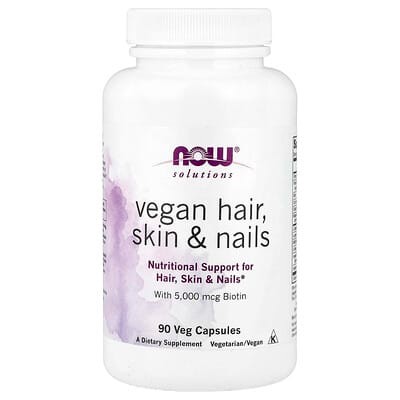
Vegan Hair Skin & Nails

NOW Solutions
4.7
★ ★ ★ ★ ★
(4251 ratings)
Copper 1 mg
Manganese 2 mg
Proline 200 mg
Cysteine 250 mg
Lysine 200 mg
Horsetail 100 mg
Product Image
Score82
A well-constructed vegan hair, skin, and nail formula with amino acids, MSM, hyaluronic acid, and chelated minerals. High biotin and unstandardized horsetail are the main limitations, and bone support is weak.
How scoring works
Quantity:90 Capsule(s) • (45 servings)
Goals:
Bone Health

Score 82

A well-constructed vegan hair, skin, and nail formula with amino acids, MSM, hyaluronic acid, and chelated minerals. High biotin and unstandardized horsetail are the main limitations, and bone support is weak.
How scoring works
$13.50($0.30 per serving)
Daily Vita
$ 17.40
iHerb
$ 18.36
Pure Formulas
$ 17.85
Amazon
$ 13.50
Report prices

Analysis

Cysteine, lysine, proline, vitamin C, and MSM provide structural building blocks relevant to keratin and collagen. Hyaluronic acid adds hydration-oriented support, while zinc bisglycinate and chelated copper and manganese round out the nutrient profile.

The amino-acid amounts are meaningful for a compact capsule formula, and the mineral forms are a strength. Horsetail is not standardized for silica, so its contribution cannot be judged precisely.

Two capsules and reasonable value make the product practical for beauty-focused users. It offers little direct bone support because calcium, vitamin D, vitamin K, and magnesium are absent.

Who is it for
  • Adults seeking a vegan beauty supplement
  • Users wanting amino acids with chelated minerals
  • People focused on hair, skin, and nails rather than bone
Best for
  • Hair and nail structural support
  • Skin hydration and collagen support
  • Vegan beauty supplementation

Pros

  • Meaningful cysteine, lysine, and proline amounts
  • Uses chelated zinc, copper, and manganese
  • Includes hyaluronic acid
  • Vegan two-capsule formula

Cons

  • Biotin amount is very high
  • Horsetail lacks silica standardization
  • No calcium or vitamin D for bone support
  • MSM amount is moderate

Warnings

  • The 5 mg biotin amount can substantially interfere with thyroid, cardiac, hormone, and other laboratory tests, so it should be disclosed before testing.
  • High biotin intake can make some test results misleading even when the user feels well.
  • Horsetail may have diuretic effects and warrants caution with diuretic medicines or fluid-balance problems.

Nutrient quality

81 Highest impact

Bisglycinate minerals, natural vitamin E, and sodium hyaluronate support strong form quality. Structural amino acids and supportive nutrients are useful, though some remain below focused standalone amounts.

.
Ingredient transparency

85 Highest impact

Every listed active has a specific amount. Serving count is clear, but complete daily use directions are not supplied.

.

Customer satisfaction

72 High impact

The aggregate rating is strong and supported by large rating volume. No specific feedback was supplied to judge repeated complaints or fit with the intended use.

.

Value for money

86 Highest impact

The strong mineral forms and broad structural support justify the asking price. Each serving provides meaningful actives at favorable cost efficiency.

.

Report analysis

Goals

Bone Health
Impact
Moderate effect
D Goal FitC Strength of SupportD+ CoverageD+ Formula Quality
Copper · 1 mgManganese · 2 mgLysine · 200 mgZinc · 8 mgProline · 200 mgVitamin C · 90 mg

Vitamin C, proline, lysine, copper, and manganese can support the collagen-rich organic framework of bone. The amino acid amounts are modest, and the formula lacks calcium, magnesium, vitamin D, and vitamin K.

Chelated minerals and clearly listed quantities support confidence in the included matrix cofactors. Most other actives are aimed at hair, skin, or nails, leaving skeletal coverage narrow.

Study evidence
Copper Disputed 20 studies
Lysine Supportive 2 studies
Manganese Adverse 12 studies
Proline Disputed 2 studies
Vitamin C Supportive 46 studies

Ingredients

IngredientAmount per serving
Vitamin C (Ascorbic Acid)
90 mg
Vitamin E (D-Alpha-Tocopherol, Sunflower Oil)
20 mg
Biotin
5 mg
Zinc (Zinc Bisglycinate)
8 mg
Copper (Copper Bisglycinate)
1 mg
Manganese (Manganese Amino Acid Chelate)
2 mg
L-Cysteine
250 mg
Lysine
200 mg
MSM
200 mg
L-Proline
200 mg
Horsetail
100 mg
Hyaluronic Acid (Sodium Hyaluronate)
50 mg
Gluten Free Adults 18–50 Vegan Dairy Free Vegetarian
Report overview
A+ Active Ingredient Quality & BioavailabilityA- Dose, Safety & Label TransparencyA- Value

Premium chelated copper pairs good absorption with a safe maintenance-level dose below the collection target. The zinc pairing falls within the intended balance range and supports routine use. A low serving cost adds strong practical value for the copper delivered.

B- Active Ingredient Quality & BioavailabilityA- Dose, Safety & Label TransparencyB+ Value

An amino acid chelate offers favorable form quality, though the specific ligand is not identified. The clearly stated 2 mg serving is suitable for maintenance but falls short of the targeted range. The moderate serving cost supports good value within a broader formula.

Proline · 200 mg OverallScore78
A+ Active Ingredient Quality & BioavailabilityC+ Dose, Safety & Label TransparencyC Value

Clearly identified L-proline and capsule delivery provide strong form quality with limited excipients. The dose is moderate and fully disclosed, though it is not a targeted high-strength serving. Cost efficiency is fair when normalized to the proline amount.

Loading alternative details
Report alternatives

Sources

Published studies used for the product analysis and the top-ranked studies for each ingredient and goal.

  1. The Manganese-Bone Connection: Investigating the Role of Manganese in Bone Health.
    Taskozhina G; Batyrova G; Umarova G; Issanguzhina Z; Kereyeva N · Journal of clinical medicine · 2024
    Narrative reviewBone Health forManganese
  2. Correlation between bone mineral density and serum trace element contents of elderly males in Beijing urban area.
    Wang L; Yu H; Yang G; Zhang Y; Wang W; Su T; Ma W; Yang F; Chen L; He L; Ma Y; Zhang Y · International journal of clinical and experimental medicine · 2016
    Cross-sectional study91 participantsBone Health forManganese
  3. Relationship between blood manganese and bone mineral density and bone mineral content in adults: A population-based cross-sectional study.
    Wang C; Zhu Y; Long H; Ou M; Zhao S · PloS one · 2022
    Cross-sectional study9,732 participantsBone Health forManganese
  4. Association of per- and polyfluoroalkylated substances/heavy metals and bone health in children and adolescents.
    Wei Y; Zhang Y; Ji Q; Yang S; Yang F · Frontiers in public health · 2024
    Cross-sectional study622 participantsBone Health forManganese
  5. The Association between Dietary and Circulating Copper Levels and Osteoporosis: a Scoping Review.
    Ju Y; Xiong W; Pang Y; Chen Z; Hou J; Zheng S; Li Z; Liu T; Xia H; Xia M; Zhong Y; Li J; Jiang X · Biological trace element research · 2026
    Scoping review18 studies pooledBone Health forCopper
  6. Association between dietary copper, iron, zinc, selenium intake and osteopenia or osteoporosis in elderly hypertensive patients: a retrospective cohort study.
    Chen M; Jia L; Gao R · Frontiers in nutrition · 2024
    Cohort study5,286 participantsBone Health forCopper
  7. Associations of dietary copper intake with total bone mineral density and lumbar spine bone mineral density in American adults.
    Hu M; Wang Z; Li C; Zheng Y; Hu J · Medicine · 2025
    Cross-sectional studyBone Health forCopper
  8. The association between dietary mineral intake and bone mineral density: a cross-sectional study.
    Wei M; Wei J; Huang S · Journal of health, population, and nutrition · 2025
    Cross-sectional study11,520 participantsBone Health forCopper
  9. Association between dietary copper intake and bone mineral density in children and adolescents aged 8-19 years: A cross-sectional study.
    Cui A; Yan J; Li H; Fan Z; Wei X; Wang H; Zhuang Y · PloS one · 2024
    Cross-sectional study6,965 participantsBone Health forCopper
  10. Amino Acid Intakes Are Associated With Bone Mineral Density and Prevalence of Low Bone Mass in Women: Evidence From Discordant Monozygotic Twins.
    Jennings A; MacGregor A; Spector T; Cassidy A · Journal of bone and mineral research : the official journal of the American Society for Bone and Mineral Research · 2016
    Cross-sectional study135 participantsBone Health forLysine
  11. Dietary L-lysine and calcium metabolism in humans.
    Civitelli R; Villareal DT; Agnusdei D; Nardi P; Avioli LV; Gennari C · Nutrition (Burbank, Los Angeles County, Calif.) · 1993
    Clinical trial75 participantsBone Health forLysine
  12. Risk of Environmental Chemicals on Bone Fractures Is Independent of Low Bone Mass in US Adults: Insights from 2017 to 2018 NHANES.
    Ling R; Ai Y; Chen C; Zhang J; Zou Z; Cheng S; Li C; Li X; Wang B · Metabolites · 2023
    Cross-sectional study2,640 participantsBone Health forManganese
  13. Associations of multiple metals with bone mineral density: A population-based study in US adults.
    Wei MH; Cui Y; Zhou HL; Song WJ; Di DS; Zhang RY; Huang Q; Liu JA; Wang Q · Chemosphere · 2021
    Cross-sectional studyBone Health forManganese
  14. Sex-specific associations of urinary mixed-metal concentrations with femoral bone mineral density among older people: an NHANES (2017-2020) analysis.
    Li H; Li G; Yi M; Zhou J; Deng Y; Huang Y; He S; Meng X; Liu L · Frontiers in public health · 2024
    Cross-sectional study31 participantsBone Health forManganese
  15. Human bone collagen synthesis is a rapid, nutritionally modulated process.
    Babraj JA; Smith K; Cuthbertson DJ; Rickhuss P; Dorling JS; Rennie MJ · Journal of bone and mineral research : the official journal of the American Society for Bone and Mineral Research · 2005
    Methods validation study8 participantsBone Health forProline
  16. Osteogenesis imperfecta: recent findings shed new light on this once well-understood condition.
    Basel D; Steiner RD · Genetics in medicine : official journal of the American College of Medical Genetics · 2009
    Narrative reviewBone Health forProline
  17. Can Dietary Intake of Vitamin C-Oriented Foods Reduce the Risk of Osteoporosis, Fracture, and BMD Loss? Systematic Review With Meta-Analyses of Recent Studies.
    Zeng LF; Luo MH; Liang GH; Yang WY; Xiao X; Wei X; Yu J; Guo D; Chen HY; Pan JK; Huang HT; Liu Q; Guan ZT; Han YH; Zhao D; Zhao JL; Hou SR; Wu M; Lin JT; Li JH; Liang WX; Ou AH; Wang Q; Li ZP; Liu J · Frontiers in endocrinology · 2020
    Meta-analysis19,484 participants17 studies pooledBone Health forVitamin C
  18. Dietary vitamin C intake and the risk of hip fracture: a dose-response meta-analysis.
    Sun Y; Liu C; Bo Y; You J; Zhu Y; Duan D; Cui H; Lu Q · Osteoporosis international : a journal established as result of cooperation between the European Foundation for Osteoporosis and the National Osteoporosis Foundation of the USA · 2019
    Meta-analysis6 studies pooledBone Health forVitamin C
  19. Smoking, antioxidant vitamins, and the risk of hip fracture.
    Melhus H; Michaëlsson K; Holmberg L; Wolk A; Ljunghall S · Journal of bone and mineral research : the official journal of the American Society for Bone and Mineral Research · 1999
    Cohort study66,651 participantsBone Health forVitamin C
  20. Micronutrients and the risk of hip fracture: Case-control study.
    Torbergsen AC; Watne LO; Wyller TB; Frihagen F; Strømsøe K; Bøhmer T; Mowe M · Clinical nutrition (Edinburgh, Scotland) · 2018
    Case-control study189 participantsBone Health forVitamin C
  21. Favorable effect of dietary vitamin C on bone mineral density in postmenopausal women (KNHANES IV, 2009): discrepancies regarding skeletal sites, age, and vitamin D status.
    Kim YA; Kim KM; Lim S; Choi SH; Moon JH; Kim JH; Kim SW; Jang HC; Shin CS · Osteoporosis international : a journal established as result of cooperation between the European Foundation for Osteoporosis and the National Osteoporosis Foundation of the USA · 2016
    Cross-sectional study1,196 participantsBone Health forVitamin C