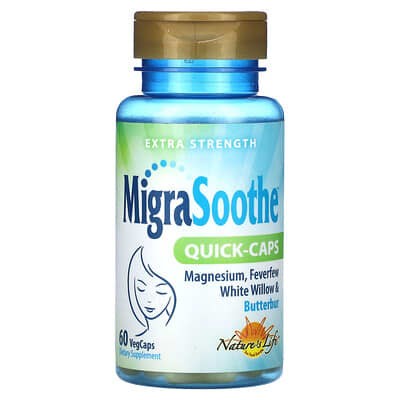
Product Image

MigraSoothe

Health From The Sun
4.5
★ ★ ★ ★ ★
(24 ratings)
Green Tea 100 mg
Product Image
Score63
Several recognized headache-support ingredients are combined at clear weights. Unverified butterbur safety, white-willow interactions, and weak standardization outweigh the formula breadth.
How scoring works
Quantity:60 VegCap(s) • (30 servings)
Goals:

Score 63

Several recognized headache-support ingredients are combined at clear weights. Unverified butterbur safety, white-willow interactions, and weak standardization outweigh the formula breadth.
How scoring works
$18.99($0.63 per serving)
iHerb
$ 18.99
iHerb
$ 18.99
Report prices

Analysis

Riboflavin at 200 mg, magnesium at 200 mg, feverfew at 250 mg, and coenzyme Q10 at 75 mg provide several relevant nutritional pathways. White willow, butterbur, and a small green-tea amount broaden the formula but add safety and disclosure demands.

Magnesium oxide is less reliably absorbed, and feverfew, white willow, and green tea lack active-marker details. Most importantly, the supplied label does not state that butterbur is free of pyrrolizidine alkaloids, a necessary safety detail for this ingredient.

Two vegetarian capsules are convenient for a multi-ingredient formula. The product is difficult to recommend without verified butterbur processing and a full interaction review, especially for people using pain or blood-thinning medicines.

Who is it for
  • Adults evaluating multi-ingredient headache support
  • People who can verify butterbur safety certification
Best for
  • Riboflavin and magnesium intake
  • Multi-pathway headache routines
  • Feverfew-based supplementation

Pros

  • Provides substantial riboflavin
  • Includes magnesium and coenzyme Q10
  • Lists each ingredient amount
  • Two-capsule serving

Cons

  • Butterbur safety processing is not stated
  • Uses magnesium oxide
  • Botanical active markers are missing
  • Green tea contribution is small

Warnings

  • Do not use butterbur unless the package verifies it is pyrrolizidine-alkaloid-free, because unsafe butterbur can damage the liver.
  • White willow should be avoided with aspirin allergy, anticoagulants, antiplatelet medicines, or in children and teenagers with viral illness.
  • Feverfew and white willow may increase bleeding risk and are generally unsuitable during pregnancy; magnesium oxide may also cause diarrhea.

Nutrient quality

62 Moderate impact

Magnesium oxide is a weaker mineral form, while the botanical extracts lack several important quality markers. Several migraine-related nutrients are meaningful, but weak forms and incomplete botanical safety details reduce confidence.

Ingredient transparency

79 High impact

Every listed active has a stated amount. No proprietary blend hides the listed active doses.

Customer satisfaction

58 Moderate impact

The supplied average is positive, with small response volume. Complaint patterns and purpose-related experiences are not supplied.

Value for money

46 Lower impact

The asking price is difficult to justify for the disclosed formula. Serving value is weak relative to the green tea support provided.

Report analysis

Ingredients

IngredientAmount per serving
Riboflavin
200 mg
Magnesium (Magnesium Oxide)
200 mg
Feverfew
250 mg
White Willow
100 mg
Green tea
100 mg
Coenzyme Q10
75 mg
Butterbur
25 mg
Adults 18–50
Report overview
Green Tea · 100 mg OverallScore0
F Active Ingredient Quality & BioavailabilityF Dose, Safety & Label TransparencyF Value

The label does not distinguish green tea extract from leaf powder, while green tea is a minor part of a complex formula without absorption support. The label does not disclose a specific EGCG amount, and caffeine content and decaffeination status are not disclosed. Green tea is secondary to the migraine-focused ingredients and lacks active-marker detail; value per active EGCG amount cannot be verified because EGCG is not disclosed.

Loading alternative details
Report alternatives