
Nutrient quality
Ground flax offers a useful whole-food nutrient base, but the fatty-acid and fiber amounts are not quantified. Modest mineral amounts fit food use without suggesting aggressive dosing.
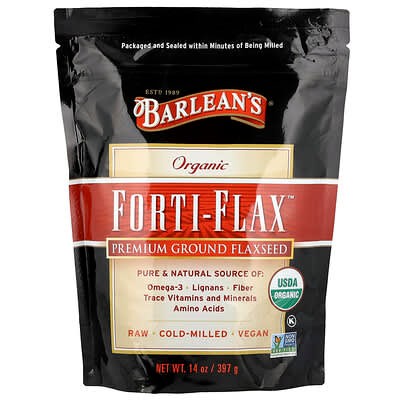
 iHerb iHerb | $ 9.49 | |
 Vitacost Vitacost | $ 8.89 |
The serving provides 6 g of fat, 3 g of protein, and 4 g of carbohydrate along with small amounts of several vitamins and minerals. Potassium at 120 mg and phosphorus at 96 mg are useful food contributions but not high-potency supplemental amounts.
Flax is usually chosen for its fatty-acid and plant-nutrient profile, yet the supplied data show no usable omega-3, omega-6, or omega-9 quantities. That omission makes it impossible to judge the balance or amount of its most relevant fats.
It fits people who want an inexpensive food-style addition rather than a targeted potassium, phosphorus, or protein supplement. Its heart-health contribution is supportive and indirect, with stronger benefit depending on the unreported flax fatty-acid content.
Ground flax offers a useful whole-food nutrient base, but the fatty-acid and fiber amounts are not quantified. Modest mineral amounts fit food use without suggesting aggressive dosing.
Principal nutrient amounts are stated clearly and no proprietary blend hides the protein serving. Complete use directions and a full other-ingredients list are not included in the supplied facts.
The supplied average rating is strong and the review volume is sufficient for a useful broad signal. No detailed comments are provided to assess repeated complaints or whether experiences match the intended use.
The low serving cost supports practical value for a simple whole-food ingredient. Missing fatty-acid and fiber amounts weaken comparison with more transparent flax products.
| Ingredient | Amount per serving |
|---|---|
Calories | 60 {Calories} |
Total Fat | 6 Gram(s) |
Total Carbohydrates | 4 Gram(s) |
Protein | 3 Gram(s) |
Vitamin C | 0.1 mg |
Vitamin E | 0.07 IU |
Thiamine (Vitamin B1) | 0.25 mg |
Riboflavin (Vitamin B2) | 0.02 mg |
Niacin | 0.46 mg |
Vitamin B6 (Pyridoxine Hydrochloride) | 0.07 mg |
Folate | 13 mcg |
Pantothenic Acid | 0.15 mg |
Calcium | 38 mg |
Iron | 0.86 mg |
Phosphorus | 96 mg |
Magnesium | 59 mg |
Zinc | 0.65 mg |
Copper | 0.18 mg |
Manganese | 0.37 mg |
Sodium | 5 mg |
Potassium | 120 mg |
Omega-3 Fatty Acids | 0 NP |
Omega-6 Fatty Acids | 0 NP |
Omega-9 Fatty Acids | 0 NP |
Amino Acids | 0 NP |
Phyto-Nutrients | 0 NP |
The clearly quantified phosphorus amount is near the targeted range but its source compound is not disclosed. The measured food-style serving is manageable for routine use. Its per-serving cost compares very favorably with the collection benchmark.
Food-derived potassium is present, but its chemical form and absorption characteristics are not identified. The 120 mg serving is below a moderate supplemental dose. Its low serving cost offers some value, though the product is not an efficient high-potency potassium source.