
Nutrient quality
Many nutrients use active, citrate, picolinate, glycinate, or selenomethionine forms at substantial amounts. High vitamin E and B-vitamin exposure may be more aggressive than many users need for routine maintenance.
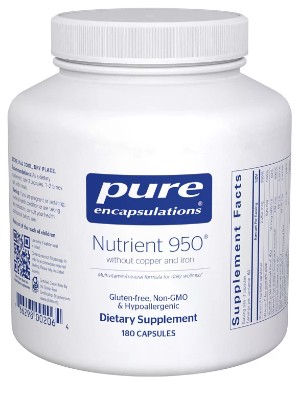
 Pure Formulas Pure Formulas | $ 63.00 | |
 Vitacost Vitacost | $ 63.00 |
Metafolin, methylcobalamin, P-5-P, riboflavin phosphate, zinc picolinate, and selenomethionine are useful form choices. Omitting copper and iron may fit users who have a specific reason to avoid those minerals.
Repeated entries for several vitamins appear to describe the same nutrients in more than one way, so actual totals need confirmation. Boron is only 1 mg, vanadium is modest, and the proprietary carotenoid blend is not broken down.
Six capsules deliver a high-potency formula at a high cost. It best fits a professionally guided plan that specifically calls for copper- and iron-free coverage.
Many nutrients use active, citrate, picolinate, glycinate, or selenomethionine forms at substantial amounts. High vitamin E and B-vitamin exposure may be more aggressive than many users need for routine maintenance.
Nearly all nutrient amounts and chemical forms are stated clearly. The mixed carotenoid blend, complete directions, and capsule excipients remain incompletely disclosed.
The exceptional average rating and limited review count make the aggregate satisfaction signal encouraging but incomplete. No detailed review text was provided, so recurring complaints and purpose alignment cannot be assessed.
High-quality forms and broad coverage provide some justification for the premium cost. Modest specialty-mineral amounts and an opaque carotenoid blend keep category value only fair.
| Ingredient | Amount per serving |
|---|---|
Vitamin A (Beta-Carotene) | 2250 mcg |
Vitamin C (Ascorbic Acid) | 500 mg |
Vitamin D (Cholecalciferol, Vitamin D3) | 10 mcg |
Vitamin E (D-Alpha-Tocopherol Succinate) | 134 mg |
Thiamine (Thiamine Hydrochloride, Vitamin B1) | 50 mg |
Riboflavin (Riboflavin 5' Phosphate) | 34.75 mg |
Niacin (Inositol Hexanicotinate, Niacinamide) | 86 mg |
Vitamin B6 (Pyridoxal 5-Phosphate, Pyridoxine Hydrochloride) | 20.5 mg |
Folate (Metafolin) | 667 mcg DFE |
Vitamin B12 (Methylcobalamin) | 500 mcg |
Biotin | 400 mcg |
Pantothenic Acid (Calcium Pantothenate, Vitamin B5) | 200 mg |
Calcium (Calcium Citrate) | 150 mg |
Iodine (Potassium Iodide) | 100 mcg |
Magnesium (Magnesium Citrate) | 100 mg |
Zinc (Zinc Picolinate) | 12.5 mg |
Selenium (Selenomethionine) | 100 mcg |
Manganese (Manganese Aspartate) | 2.5 mg |
Chromium (Chromium Polynicotinate) | 100 mcg |
Molybdenum (Molybdenum Aspartate) | 50 mcg |
Potassium (Potassium Aspartate) | 49.5 mg |
Boron (Boron Glycinate) | 1 mg |
Vanadium (Vanadium Aspartate) | 100 mcg |
Proprietary Mixed Carotenoid Blend | 425 mcg |
Vanadium aspartate is an organic acid chelate but not a named premium form. The 100 mcg amount provides a meaningful supplemental dose within the preferred safety range. Serving value is weak because cost is well above the collection median.
Boron glycinate is a well-defined organic source with useful absorption potential. The disclosed 1 mg serving is conservative and falls short of the main supplemental target range. Normalized value is poor because the broader formula is costly when boron is the main goal.