Product Image

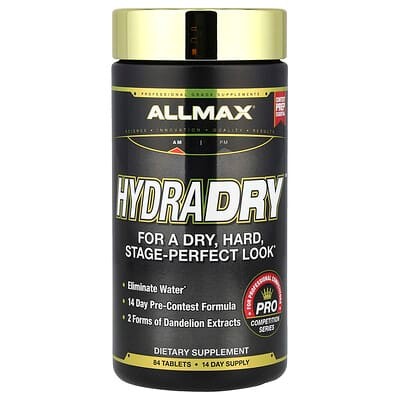
HydraDry

ALLMAX
4.5
★ ★ ★ ★ ★
(647 ratings)
Calcium 255 mg
Vitamin B6 17 mg
Green Tea 300 mg
Horsetail 150 mg
Product Image
Score70
A meaningful green tea extract is surrounded by multiple diuretic botanicals, making the formula better suited to temporary water loss than sustained health support. Dandelion, uva-ursi, horsetail, parsley, and related herbs may worsen dehydration or electrolyte loss, especially during heat, exercise, or use with diuretic medicines.
How scoring works
Quantity:84 Tablet(s) • (28 servings)
Goals:
Anti-Inflammatory Support

Score 70

A meaningful green tea extract is surrounded by multiple diuretic botanicals, making the formula better suited to temporary water loss than sustained health support. Dandelion, uva-ursi, horsetail, parsley, and related herbs may worsen dehydration or electrolyte loss, especially during heat, exercise, or use with diuretic medicines.
How scoring works
$14.99($0.53 per serving)
Nutrition Faktory
$ 14.99
Nutrition Faktory
$ 14.99
iHerb
$ 16.63
Report prices

Analysis

A meaningful green tea extract is surrounded by multiple diuretic botanicals, making the formula better suited to temporary water loss than sustained health support. Dandelion, uva-ursi, horsetail, parsley, and related herbs may worsen dehydration or electrolyte loss, especially during heat, exercise, or use with diuretic medicines.

The hydration formula uses a highly bioavailable citrate-malate calcium source. The 255 mg serving supports general supplementation but may not meet higher needs alone.

The disclosed 300 mg EGCG amount provides meaningful green-tea support for antioxidant and inflammatory signaling. Missing caffeine disclosure and percentage standardization leave important safety and quality uncertainty.

Who is it for
  • Adults focused on anti-inflammatory support
  • Adults focused on skin health
  • Adults focused on anti-aging
Best for
  • Calcium supplementation
  • Vitamin B6 supplementation
  • Green Tea supplementation

Pros

  • Provides a disclosed 300.00mg of green tea leaf extract
  • Provides a disclosed 345.00mg of dandelion root extract
  • Includes uva ursi for a clearly stated role

Cons

  • Multiple diuretic herbs can worsen dehydration
  • Uva ursi is not suited to prolonged routine use
  • The formula favors temporary water loss over sustained support

Warnings

  • Dandelion, uva ursi, horsetail, parsley, and related herbs may worsen dehydration or electrolyte loss.
  • Uva ursi is not suited to prolonged routine use and may be inappropriate with kidney disease.
  • Avoid combining the formula with prescription diuretics unless medically coordinated.

Nutrient quality

68 High impact

Calcium citrate malate and standardized botanical extracts support useful ingredient quality. Green tea and dandelion are substantial, while magnesium, potassium, and cranberry are modest.

.

Ingredient transparency

80 Highest impact

Active amounts and several extract markers are clear, though repeated marker entries require careful reading. Complete non-active ingredient details are not included in the supplied label data.

.

Customer satisfaction

68 High impact

The supplied average rating provides limited high-level context. Detailed firsthand feedback is unavailable, so recurring complaints and purpose fit cannot be assessed.

.

Value for money

58 Moderate impact

Standardized extracts support reasonable quality for the moderate serving cost. Meaningful green tea and dandelion amounts support value despite weak electrolyte replacement.

.

Report analysis

Goals

Anti-Inflammatory Support
Impact
Moderate effect
B- Goal FitB Strength of SupportD+ CoverageF Formula Quality
Green Tea · 300 mg

The disclosed 300 mg EGCG amount provides meaningful green-tea support for antioxidant and inflammatory signaling. Missing caffeine disclosure and percentage standardization leave important safety and quality uncertainty.

The many diuretic botanicals make the formula primarily a fluid-loss product rather than balanced inflammatory support. Dandelion, uva-ursi, horsetail, and related ingredients may worsen dehydration or electrolyte loss, especially with diuretic medicines.

Study evidence
Green Tea Mixed 16 studies

Ingredients

IngredientAmount per serving
Vitamin B6 (Pyridoxine Hydrochloride)
17 mg
Calcium (Calcium Citrate Malate)
255 mg
Magnesium (Magnesium Aspartate)
10 mg
Potassium (Potassium Citrate)
33 mg
Dandelion Root Extract (Inulin)
345 mg
Green Tea Leaf Extract (Catechins, Epigallocatechin Gallate, Polyphenols)
300 mg
Dandelion Root Extract (Vitexin)
255 mg
Horsetail Whole Plant Extract (Silica)
150 mg
Uva-Ursi (Arctostaphylos uva-ursi) leaf extract (Arbutins)
85 mg
Sevenbark (Hydrangea arborescens root) 4:1 extract
55 mg
Buchu (Agathosma betulina) leaf extract
55 mg
Parsley Leaf Extract
37 mg
Cranberry Fruit Extract (Quinic Acid)
11 mg
Adults 18–50 Women
Report overview
A+ Active Ingredient Quality & BioavailabilityB+ Dose, Safety & Label TransparencyD+ Value

The hydration formula uses a highly bioavailable citrate-malate calcium source. The 255 mg serving supports general supplementation but may not meet higher needs alone. The serving cost is moderately above the collection midpoint. Calcium can reduce absorption of levothyroxine and tetracycline or quinolone antibiotics, so users should separate doses according to their prescription directions.

D+ Active Ingredient Quality & BioavailabilityA Dose, Safety & Label TransparencyF Value

The 17 mg pyridoxine amount is well targeted but lacks a disclosed riboflavin cofactor. Three tablets reduce convenience and the formula is designed mainly for fluid-balance support. The precursor-form vitamin B6 is costly relative to the serving.

F Active Ingredient Quality & BioavailabilityC Dose, Safety & Label TransparencyB Value

The green tea extract discloses a substantial EGCG amount but lacks percentage standardization and absorption support. Its active dose fits the preferred range and offers competitive cost efficiency, yet caffeine content is not stated. Dandelion, uva-ursi, horsetail, and other diuretic botanicals may increase fluid and electrolyte loss, which matters during dehydration or use with diuretic medicines.

Loading alternative details
Report alternatives

Sources

Published studies used for the product analysis and the top-ranked studies for each ingredient and goal.

  1. Effects of green tea supplementation on antioxidant status and inflammatory markers in adults: a grade-assessed systematic review and dose-response meta-analysis of randomised controlled trials.
    Dehzad MJ; Ghalandari H; Nouri M; Makhtoomi M; Askarpour M · Journal of nutritional science · 2025
    Meta-analysis38 studies pooledAnti-Inflammatory Support forGreen Tea
  2. Effects of supplementation with green tea catechins on plasma C-reactive protein concentrations: A systematic review and meta-analysis of randomized controlled trials.
    Serban C; Sahebkar A; Antal D; Ursoniu S; Banach M · Nutrition (Burbank, Los Angeles County, Calif.) · 2016
    Meta-analysis11 studies pooledAnti-Inflammatory Support forGreen Tea
  3. The effects of green tea on acne vulgaris: A systematic review and meta-analysis of randomized clinical trials.
    Kim S; Park TH; Kim WI; Park S; Kim JH; Cho MK · Phytotherapy research : PTR · 2021
    Meta-analysis247 participants5 studies pooledAnti-Inflammatory Support forGreen Tea
  4. Green Tea Catechin Association with Ultraviolet Radiation-Induced Erythema: A Systematic Review and Meta-Analysis.
    Kapoor MP; Sugita M; Fukuzawa Y; Timm D; Ozeki M; Okubo T · Molecules (Basel, Switzerland) · 2021
    Meta-analysis100 participants6 studies pooledAnti-Inflammatory Support forGreen Tea
  5. Effects of Green Tea Extract Supplementation on Inflammatory Cytokines Among Postmenopausal Women with Overweight or Obesity-A Secondary Analysis of a Randomized Controlled Trial.
    Cunningham A; Gomes A; Meng L; Shapses S; Byham-Gray L; Samavat H · Nutrients · 2026
    Randomized trial97 participantsAnti-Inflammatory Support forGreen Tea
  6. Effect of Green Tea Supplementation on Inflammatory Markers among Patients with Metabolic Syndrome and Related Disorders: A Systematic Review and Meta-Analysis.
    de Oliveira Assis FS; Vasconcellos GL; Lopes DJP; de Macedo LR; Silva M · Preventive nutrition and food science · 2024
    Meta-analysis15 studies pooledAnti-Inflammatory Support forGreen Tea
  7. A green tea extract confection decreases circulating endotoxin and fasting glucose by improving gut barrier function but without affecting systemic inflammation: A double-blind, placebo-controlled randomized trial in healthy adults and adults with metabolic syndrome.
    Zeng M; Hodges JK; Pokala A; Khalafi M; Sasaki GY; Pierson J; Cao S; Brock G; Yu Z; Zhu J; Vodovotz Y; Bruno RS · Nutrition research (New York, N.Y.) · 2024
    Randomized trial40 participantsAnti-Inflammatory Support forGreen Tea
  8. Efficacy of (-)-epigallocatechin gallate delivered by a new-type scaler tip during scaling and root planing on chronic periodontitis: a split-mouth, randomized clinical trial.
    Wang Y; Zeng J; Yuan Q; Luan Q · BMC oral health · 2021
    Randomized trial20 participantsAnti-Inflammatory Support forGreen Tea
  9. Functional foods modulating inflammation and metabolism in chronic diseases: a systematic review.
    Luvián-Morales J; Varela-Castillo FO; Flores-Cisneros L; Cetina-Pérez L; Castro-Eguiluz D · Critical reviews in food science and nutrition · 2022
    Systematic review88 studies pooledAnti-Inflammatory Support forGreen Tea
  10. Does green tea extract enhance the anti-inflammatory effects of exercise on fat loss?
    Bagheri R; Rashidlamir A; Ashtary-Larky D; Wong A; Alipour M; Motevalli MS; Chebbi A; Laher I; Zouhal H · British journal of clinical pharmacology · 2021
    Randomized trial30 participantsAnti-Inflammatory Support forGreen Tea
  11. Camellia Sinensis Mouthwashes in Oral Care: a Systematic Review.
    Tafazoli A; Tafazoli Moghadam E · Journal of dentistry (Shiraz, Iran) · 2020
    Systematic review69 studies pooledAnti-Inflammatory Support forGreen Tea
  12. Skin photoprotection by green tea: antioxidant and immunomodulatory effects.
    Katiyar SK · Current drug targets. Immune, endocrine and metabolic disorders · 2004
    Narrative reviewAnti-Inflammatory Support forGreen Tea