Product Image

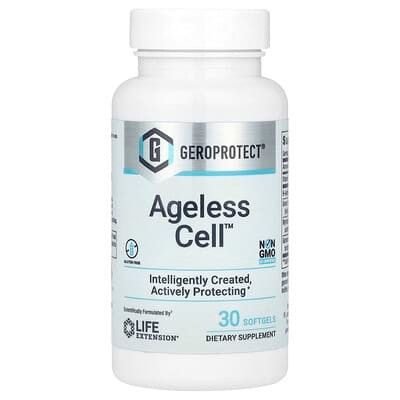
Ageless Cell

Life Extension Geroprotect
4.5
★ ★ ★ ★ ★
(774 ratings)
Green Tea 223 mg
Product Image
Score78
A well-built antioxidant blend centered on NAC and decaffeinated EGCG. Clear dosing is a strength, while value and incomplete source details are the main trade-offs.
How scoring works
Quantity:30 Softgel(s) • (30 servings)
Goals:
Anti-Aging

Score 78

A well-built antioxidant blend centered on NAC and decaffeinated EGCG. Clear dosing is a strength, while value and incomplete source details are the main trade-offs.
How scoring works
$30.00($1.00 per serving)
Amazon
$ 30.00
iHerb
$ 30.00
Vitacost
$ 30.00
Pure Formulas
$ 30.00
Report prices

Analysis

N-acetyl-L-cysteine at 450 mg provides a meaningful glutathione precursor, while 223 mg decaffeinated EGCG adds substantial green-tea polyphenol support. Myricetin, gamma tocotrienol, and natural vitamin E broaden the antioxidant pathways without a proprietary blend.

Every active amount is disclosed, and the decaffeinated extract improves stimulant predictability. Myricetin and tocotrienol source standardization are not fully described, and the formula does not establish direct effects on longevity itself.

One softgel offers a convenient, concentrated combination for users deliberately seeking NAC plus polyphenols. The price is less attractive than buying simpler single ingredients, but the coordinated formula saves serving complexity.

Who is it for
  • Adults seeking combined NAC and green-tea polyphenols
  • People who prefer a one-softgel antioxidant blend
Best for
  • Glutathione precursor intake
  • Decaffeinated EGCG supplementation
  • Multi-pathway antioxidant support

Pros

  • Provides 450 mg N-acetyl-L-cysteine
  • Includes 223 mg decaffeinated EGCG
  • Discloses every active amount
  • One-softgel serving

Cons

  • Only moderate value
  • Myricetin standardization is not supplied
  • Tocotrienol source detail is limited
  • Anti-aging outcome claims remain indirect

Warnings

  • N-acetyl-L-cysteine can intensify headache or low blood pressure from nitroglycerin.
  • Concentrated green tea extract has occasionally been linked with liver injury, particularly when taken fasting; stop use for dark urine, jaundice, or persistent upper-abdominal pain.
  • Vitamin E and tocotrienols may add to bleeding risk with anticoagulant or antiplatelet medicines.

Nutrient quality

92 Highest impact

Natural vitamin E, N-acetyl-L-cysteine, decaffeinated EGCG, and tocotrienols are useful forms. A coherent antioxidant network and measured decaffeinated EGCG provide strong quality, with premium serving cost as the main trade-off.

Ingredient transparency

87 Highest impact

Every listed active has a stated amount. No proprietary blend hides the listed active doses.

Customer satisfaction

67 High impact

The supplied average is positive, with moderate response volume. Complaint patterns and purpose-related experiences are not supplied.

Value for money

57 Moderate impact

The asking price is only partly justified by the disclosed formula. Serving value is weak relative to the green tea support provided.

Report analysis

Goals

Anti-Aging
Impact
Highest effect
B Goal FitA- Strength of SupportB CoverageA- Formula Quality
Green Tea · 223 mg

N-acetyl cysteine, EGCG, vitamin E, and tocotrienols form a strong antioxidant and cellular-defense formula. Decaffeinated green tea provides an effective EGCG amount without a stimulant burden.

The blend covers glutathione production, lipid protection, and inflammatory balance with generally meaningful amounts. Myricetin has less developed human evidence, but it does not dominate the formula.

Study evidence
Green Tea Supportive 9 studies
Vitamin E Supportive 19 studies

Ingredients

IngredientAmount per serving
Vitamin E (D-Alpha-Tocopherol)
13.4 mg
N-Acetyl-L-Cysteine
450 mg
Green Tea decaffeinated extract (EGCG)
223 mg
Myricetin (Myrica cerifera extract)
50 mg
Gamma Tocotrienol (natural Tocotrienol/Tocopherol complex)
25 mg
Adults 18–50
Report overview
Green Tea (EGCG) · 223 mg OverallScore75
B Active Ingredient Quality & BioavailabilityA+ Dose, Safety & Label TransparencyF Value

The decaffeinated extract provides 223 mg EGCG within the effective range. No delivery technology is listed to improve catechin absorption. The premium cost per active target limits value despite strong dose clarity.

Loading alternative details
Report alternatives

Sources

Published studies used for the product analysis and the top-ranked studies for each ingredient and goal.

  1. Green tea and coffee intake and risk of cognitive decline in older adults: the National Institute for Longevity Sciences, Longitudinal Study of Aging.
    Shirai Y; Kuriki K; Otsuka R; Kato Y; Nishita Y; Tange C; Tomida M; Imai T; Ando F; Shimokata H · Public health nutrition · 2021
    Cohort study1,305 participantsAnti-Aging forGreen Tea
  2. Associations of green tea, coffee, and soft drink consumption with longitudinal changes in leukocyte telomere length.
    Sohn I; Shin C; Baik I · Scientific reports · 2023
    Cohort study1,952 participantsAnti-Aging forGreen Tea
  3. Can teatime increase one's lifetime?
    Nakachi K; Eguchi H; Imai K · Ageing research reviews · 2003
    Cohort studyAnti-Aging forGreen Tea
  4. Influences of tea consumption on self-rated health and life satisfaction among older adults: Evidence from the CLHLS.
    Zou M; Sun C; Yang M; Li C; Wang S; Zheng D; Wang J; Yu L; Sun L; Wang Y; Chen H; Zeng Y · PsyCh journal · 2025
    Cohort study78,345 participantsAnti-Aging forGreen Tea
  5. Double-blinded, placebo-controlled trial of green tea extracts in the clinical and histologic appearance of photoaging skin.
    Chiu AE; Chan JL; Kern DG; Kohler S; Rehmus WE; Kimball AB · Dermatologic surgery : official publication for American Society for Dermatologic Surgery [et al.] · 2005
    Randomized trial40 participantsAnti-Aging forGreen Tea
  6. Low dietary vitamin E intake is associated with high risk of incident dementia among older adults: The Shanghai Aging Study.
    Liu S; Luo J; Xiao Z; Wu W; Liang X; Ding S; Zhao Q; Zhao X; Wang Y; Ding D · Frontiers in nutrition · 2024
    Cohort study1,550 participantsAnti-Aging forVitamin E
  7. Nutrients and bioactives in green leafy vegetables and cognitive decline: Prospective study.
    Morris MC; Wang Y; Barnes LL; Bennett DA; Dawson-Hughes B; Booth SL · Neurology · 2019
    Cohort study960 participantsAnti-Aging forVitamin E
  8. Low Intake of Vitamin E Accelerates Cellular Aging in Patients With Established Cardiovascular Disease: The CORDIOPREV Study.
    Corina A; Rangel-Zúñiga OA; Jiménez-Lucena R; Alcalá-Díaz JF; Quintana-Navarro G; Yubero-Serrano EM; López-Moreno J; Delgado-Lista J; Tinahones F; Ordovás JM; López-Miranda J; Pérez-Martínez P · The journals of gerontology. Series A, Biological sciences and medical sciences · 2020
    Observational study1,002 participantsAnti-Aging forVitamin E
  9. The L-shaped link between total antioxidant capacity and phenotypic age acceleration: evidence from NHANES 2003-2010.
    Wu Y; Xiang M; Zhao Y; Zhang Y; Cheng W; Deng J · Biogerontology · 2025
    Cross-sectional study16,395 participantsAnti-Aging forVitamin E
  10. Serum levels of vitamin E forms and risk of cognitive impairment in a Finnish cohort of older adults.
    Mangialasche F; Solomon A; Kåreholt I; Hooshmand B; Cecchetti R; Fratiglioni L; Soininen H; Laatikainen T; Mecocci P; Kivipelto M · Experimental gerontology · 2014
    Cohort study140 participantsAnti-Aging forVitamin E