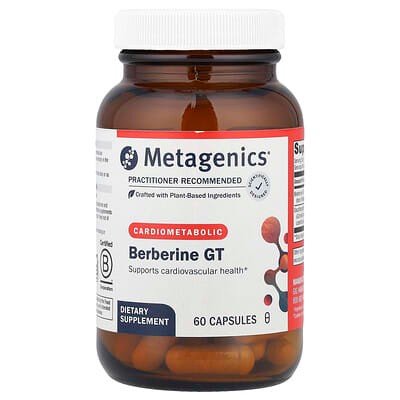

Product Image

Berberine GT

Metagenics
4.8
★ ★ ★ ★ ★
(176 ratings)
Green Tea 200 mg
Product Image
Score69
A strong berberine-and-green-tea combination with meaningful amounts. Conflicting caffeine information and substantial interaction potential require careful label verification.
How scoring works
Quantity:60 Capsule(s) • (60 servings)
Goals:
Anti-Aging

Score 69

A strong berberine-and-green-tea combination with meaningful amounts. Conflicting caffeine information and substantial interaction potential require careful label verification.
How scoring works
$44.00($0.73 per serving)
iHerb
$ 44.95
Pure Formulas
$ 44.00
iHerb
$ 44.00
Report prices

Analysis

Berberine hydrochloride is supplied at 500 mg, while decaffeinated green-tea extract contributes catechin and EGCG markers. The combination is directly relevant to glucose and lipid metabolism rather than broad anti-aging support.

The supplied data also list 200 mg under a caffeine form despite describing the extract as decaffeinated. That internal inconsistency needs package-label verification because it changes both tolerability and safe timing.

One capsule is convenient and the active amounts are substantial, though gastrointestinal tolerance and medication interactions matter more than serving simplicity. The formula best suits informed users who specifically want berberine plus green-tea catechins.

Who is it for
  • Adults deliberately seeking berberine with green-tea catechins
  • People using a clinician-guided metabolic-support plan
Best for
  • Berberine supplementation
  • Glucose-metabolism support
  • Combined berberine and EGCG intake

Pros

  • Provides 500 mg berberine hydrochloride
  • Identifies catechin and EGCG amounts
  • One-capsule serving
  • Focused two-active concept

Cons

  • Caffeine labeling is internally inconsistent
  • Berberine has extensive interaction potential
  • May cause gastrointestinal discomfort
  • Only moderate value

Warnings

  • Berberine may add to insulin, sulfonylureas, or other glucose-lowering medicines and can cause hypoglycemia without monitoring.
  • Berberine can affect the handling of many prescription medicines and is generally avoided during pregnancy and breastfeeding.
  • The conflicting decaffeinated and caffeine entries must be checked on the package before use, especially by caffeine-sensitive users.

Nutrient quality

85 Highest impact

Decaffeinated green tea markers and berberine hydrochloride are useful forms, but the caffeine entry conflicts with the decaffeinated claim. Meaningful actives support the concept, but conflicting stimulant data and berberine interaction potential are important trade-offs.

Ingredient transparency

73 High impact

Repeated green tea marker amounts and a contradictory caffeine entry make the label internally unclear. No proprietary blend hides the listed active doses.

Customer satisfaction

66 High impact

The supplied average is very strong, with limited response volume. Complaint patterns and purpose-related experiences are not supplied.

Value for money

48 Lower impact

The asking price is difficult to justify for the disclosed formula. Serving value is weak relative to the green tea support provided.

Report analysis

Goals

Anti-Aging
Impact
Highest effect
B Goal FitB Strength of SupportB+ CoverageA- Formula Quality
Green Tea · 200 mg

Berberine and EGCG provide complementary metabolic, antioxidant, and inflammatory support. Both actives appear at meaningful amounts, creating more pathway breadth than a single-ingredient product.

The data call the green tea extract decaffeinated but also list 200 mg of caffeine, so stimulant exposure is unclear. That discrepancy matters for people with caffeine sensitivity, sleep problems, or stimulant-sensitive heart rhythm symptoms and should be resolved from the package label before use.

Study evidence
Green Tea Supportive 9 studies

Ingredients

IngredientAmount per serving
Berberine HCl (Phellodendron amurense bark extract)
500 mg
decaffeinated Green Tea (Camellia sinensis) leaf extract (Catechins, Epigallocatechin Gallate, Caffeine)
200 mg
Gluten Free Adults 18–50 Women Vegetarian
Report overview
B Active Ingredient Quality & BioavailabilityA+ Dose, Safety & Label TransparencyF Value

The label discloses a 200 mg EGCG amount from decaffeinated green tea extract, placing it in the effective range. No delivery technology is included to improve catechin absorption. The cost per active target amount is high, and berberine remains the formula's main focus.

Loading alternative details
Report alternatives

Sources

Published studies used for the product analysis and the top-ranked studies for each ingredient and goal.

  1. Double-blinded, placebo-controlled trial of green tea extracts in the clinical and histologic appearance of photoaging skin.
    Chiu AE; Chan JL; Kern DG; Kohler S; Rehmus WE; Kimball AB · Dermatologic surgery : official publication for American Society for Dermatologic Surgery [et al.] · 2005
    Randomized trial40 participantsAnti-Aging forGreen Tea
  2. Prospective Associations between Single Foods, Alzheimer's Dementia and Memory Decline in the Elderly.
    Fischer K; Melo van Lent D; Wolfsgruber S; Weinhold L; Kleineidam L; Bickel H; Scherer M; Eisele M; van den Bussche H; Wiese B; König HH; Weyerer S; Pentzek M; Röhr S; Maier W; Jessen F; Schmid M; Riedel-Heller SG; Wagner M · Nutrients · 2018
    Cohort study2,622 participantsAnti-Aging forGreen Tea
  3. Associations of green tea, coffee, and soft drink consumption with longitudinal changes in leukocyte telomere length.
    Sohn I; Shin C; Baik I · Scientific reports · 2023
    Cohort study1,952 participantsAnti-Aging forGreen Tea
  4. Can teatime increase one's lifetime?
    Nakachi K; Eguchi H; Imai K · Ageing research reviews · 2003
    Cohort studyAnti-Aging forGreen Tea
  5. Influences of tea consumption on self-rated health and life satisfaction among older adults: Evidence from the CLHLS.
    Zou M; Sun C; Yang M; Li C; Wang S; Zheng D; Wang J; Yu L; Sun L; Wang Y; Chen H; Zeng Y · PsyCh journal · 2025
    Cohort study78,345 participantsAnti-Aging forGreen Tea
  6. Tea and bone health: steps forward in translational nutrition.
    Shen CL; Chyu MC; Wang JS · The American journal of clinical nutrition · 2014
    Narrative reviewAnti-Aging forGreen Tea
  7. Green tea and coffee intake and risk of cognitive decline in older adults: the National Institute for Longevity Sciences, Longitudinal Study of Aging.
    Shirai Y; Kuriki K; Otsuka R; Kato Y; Nishita Y; Tange C; Tomida M; Imai T; Ando F; Shimokata H · Public health nutrition · 2021
    Cohort study1,305 participantsAnti-Aging forGreen Tea