
Nutrient quality
Broad micronutrient coverage and the iron-free design fit the intended older-adult audience. Basic mineral forms and several unnecessarily high B-vitamin amounts reduce quality and balance.
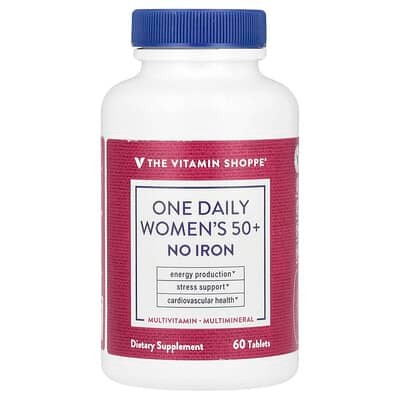
.
 iHerb iHerb | $ 22.99 |
The iron-free design suits many women over 50 who do not need supplemental iron. Vitamin D3, vitamin C, B vitamins, lutein, iodine, selenium, and chromium provide broad daily coverage.
Calcium and magnesium rely partly on carbonate or oxide forms, while zinc and copper use sulfate forms. Folate, vitamin B6, and biotin are present at high amounts that may be unnecessary in a general daily formula.
A once-daily tablet keeps the routine simple, and the absence of iron avoids a common source of digestive discomfort. People using thyroid medicine or blood thinners should pay attention to the iodine and vitamin K content.
Broad micronutrient coverage and the iron-free design fit the intended older-adult audience. Basic mineral forms and several unnecessarily high B-vitamin amounts reduce quality and balance.
.Most active amounts and forms are visible without a hidden blend. Missing excipients and directions plus duplicate thiamine and calcium entries make the panel harder to interpret.
.The aggregate rating is positive but not exceptional. The smaller feedback base and missing review details limit interpretation.
.A broad iron-free formula and daily tablet support fair value. Basic forms, dose imbalance, and limited feedback volume keep it from standing out.
.| Ingredient | Amount per serving |
|---|---|
Vitamin A (Beta-Carotene) | 2250 mcg RAE |
Vitamin C (Ascorbic Acid) | 100 mg |
Vitamin D3 (Cholecalciferol) | 50 mcg |
Vitamin E (D-Alpha-Tocopheryl Succinate) | 25 mg |
Vitamin K (Phytonadione) | 45 mcg |
Thiamine (Thiamine Mononitrate, Vitamin B1) | 10 mg |
Riboflavin (Vitamin B2) | 10 mg |
Niacin (Niacinamide) | 20 mg NE |
Vitamin B6 (Pyridoxine Hydrochloride) | 20 mg |
Folate | 1360 mcg DFE |
Vitamin B12 (Cyanocobalamin) | 25 mcg |
Biotin (D-Biotin) | 600 mcg |
Pantothenic Acid (D-Calcium Pantothenate) | 10 mg |
Choline (Choline Bitartrate) | 50 mg |
Calcium (Calcium Carbonate, Dicalcium Phosphate) | 300 mg |
Iodine (Kelp) | 150 mcg |
Magnesium (Magnesium Oxide) | 200 mg |
Zinc (Zinc Sulfate) | 15 mg |
Selenium (Selenium Amino Acid Chelate) | 55 mcg |
Copper (Copper Sulfate) | 1 mg |
Manganese (Manganese Sulfate) | 2 mg |
Chromium (Chromium Picolinate) | 120 mcg |
Molybdenum (Molybdenum Amino Acid Chelate) | 75 mcg |
Chloride (Potassium Chloride) | 69 mg |
Potassium (Potassium Chloride) | 75 mg |
Cranberry concentrate | 80 mg |
Boron Glycinate | 1 mg |
Lutein | 5 mg |
Potassium chloride supplies a soluble functional salt with an additional useful cation, and the 69 mg amount provides only a low contribution to daily chloride intake. The tablet uses conventional delivery, while the label clearly identifies both dose and source. Cost efficiency is good for the chloride delivered.
Boron glycinate offers a useful organic chelate, but no premium source verification is provided. The 1 mg amount is below maintenance and clinical target ranges but not entirely negligible. A modest serving cost still produces weak boron value because the amount is low.