Product Image

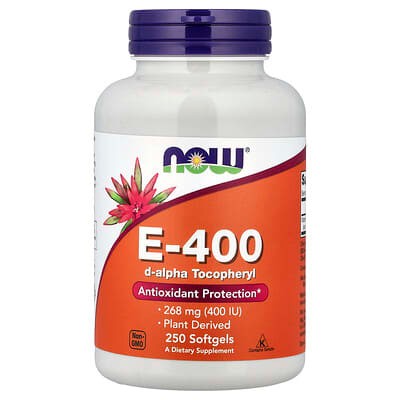
Natural E-400

NOW
4.8
★ ★ ★ ★ ★
(13651 ratings)
Vitamin E 400 IU
Product Image
Score84
A convenient and economical natural alpha-tocopherol supply works for focused use but lacks vitamin E-family breadth.
How scoring works
Quantity:250 Softgel(s) • (250 servings)
Goals:
Anti-Inflammatory Support
Cardiovascular Support
Vision Support

Score 84

A convenient and economical natural alpha-tocopherol supply works for focused use but lacks vitamin E-family breadth.
How scoring works
$26.60($0.10 per serving)
Daily Vita
$ 26.60
Vitacost
$ 43.99
iHerb
$ 28.16
Report prices

Analysis

Natural d-alpha-tocopheryl acetate is clearly identified and delivered at a substantial amount. The one-softgel serving is simple and well suited to focused vitamin E use.

No mixed tocopherols or tocotrienols broaden the antioxidant profile. Users wanting the wider vitamin E family should choose a more diverse formula rather than relying on alpha-tocopherol alone.

The very long supply creates strong everyday value and reduces the need for frequent repurchase. Goal coverage remains narrow because the product does not include complementary carotenoids, minerals, fatty acids, or vascular-support ingredients.

Who is it for
  • Adults seeking natural alpha-tocopherol
  • Regular vitamin E users
  • People prioritizing a long supply
Best for
  • Focused vitamin E intake
  • Routine antioxidant support
  • Simple one-softgel use

Pros

  • Natural vitamin E form
  • Substantial amount
  • One-softgel serving
  • Very long supply

Cons

  • Alpha-tocopherol only
  • No tocotrienols
  • Limited pathway coverage

Warnings

  • The substantial vitamin E amount may increase bleeding tendency in people using warfarin or similar anticoagulant medicines.

Nutrient quality

84 Highest impact

Natural vitamin E provides a meaningful amount in a focused formula. The alpha-only profile is narrow, and the substantial amount warrants care with blood-thinning medicines.

.

Ingredient transparency

83 Highest impact

Active ingredients and their amounts are mostly clear without a hidden proprietary total. Daily directions and a complete other-ingredients panel are not included in the supplied data.

.

Customer satisfaction

73 High impact

The aggregate rating is favorable and supported by large feedback volume. Complaint-level experiences are unavailable, so repeated drawbacks and purpose fit remain uncertain.

.

Value for money

96 Highest impact

Useful active amounts and a low serving cost provide strong practical value. Minor formula limitations do not outweigh the economy.

.

Report analysis

Goals

Anti-Inflammatory Support
Impact
High effect
B Goal FitB+ Strength of SupportC- CoverageA- Formula Quality
Vitamin E · 400 IU

Natural d-alpha vitamin E at 400 IU provides substantial membrane antioxidant support. The dose may help limit oxidative damage that can sustain inflammatory signaling.

Only alpha-tocopherol is included, so the antioxidant profile is narrower than a mixed-tocopherol formula. A substantial vitamin E dose can increase bleeding tendency in people using warfarin or similar anticoagulants.

Study evidence
Vitamin E Supportive 20 studies
Cardiovascular Support
Impact
High effect
C Goal FitA- Strength of SupportD CoverageA- Formula Quality
Vitamin E · 400 IU

The natural alpha-tocopherol form provides a substantial dose of lipid-soluble antioxidant support. Its clearest cardiovascular role is helping protect lipids from oxidative damage.

The formula is narrowly focused and does not address blood flow, lipid levels, or heart rhythm directly. It also omits mixed tocopherols and tocotrienols, which limits the range of vitamin E compounds provided.

Study evidence
Vitamin E Mixed 79 studies
Vision Support
Impact
High effect
C+ Goal FitA- Strength of SupportD CoverageB+ Formula Quality
Vitamin E · 400 IU

Natural vitamin E supports retinal antioxidant defense but does not provide macular pigment or retinal lipids. Vitamin E is part of established eye-health nutrient frameworks, though evidence does not support using it as a complete standalone formula.

The vitamin E amount is substantial and falls within a commonly used antioxidant range. Natural d-alpha tocopheryl acetate is clearly identified, but no mixed tocopherols or tocotrienols are included.

Study evidence
Vitamin E Disputed 35 studies

Ingredients

IngredientAmount per serving
Vitamin E (D-Alpha-Tocopheryl Acetate)
400 IU
Gluten Free Adults 18–50 Kosher Dairy Free
Report overview
D Active Ingredient Quality & BioavailabilityA+ Dose, Safety & Label TransparencyA+ Value

Natural d-alpha vitamin E offers better biological activity than a synthetic form, but the formula lacks broader vitamin E isomers. The amount falls within the established range for general antioxidant support. Cost efficiency is favorable for the natural form provided.

Loading alternative details
Report alternatives

Sources

Published studies used for the product analysis and the top-ranked studies for each ingredient and goal.

  1. Effects of delta-tocotrienol supplementation on Glycemic Control, oxidative stress, inflammatory biomarkers and miRNA expression in type 2 diabetes mellitus: A randomized control trial.
    Mahjabeen W; Khan DA; Mirza SA; Pervez MA · Phytotherapy research : PTR · 2021
    Randomized trial110 participantsAnti-Inflammatory Support forVitamin E
  2. Effect of vitamin E supplementation on serum C-reactive protein level: a meta-analysis of randomized controlled trials.
    Saboori S; Shab-Bidar S; Speakman JR; Yousefi Rad E; Djafarian K · European journal of clinical nutrition · 2016
    Meta-analysis495 participants12 studies pooledAnti-Inflammatory Support forVitamin E
  3. Efficacy of Nutritional Interventions on Inflammatory Markers in Haemodialysis Patients: A Systematic Review and Limited Meta-Analysis.
    Khor BH; Narayanan SS; Sahathevan S; Gafor AHA; Daud ZAM; Khosla P; Sabatino A; Fiaccadori E; Chinna K; Karupaiah T · Nutrients · 2018
    Meta-analysis46 studies pooledAnti-Inflammatory Support forVitamin E
  4. Vitamin E improves serum markers and histology in adults with metabolic dysfunction-associated steatotic liver disease: Systematic review and meta-analysis.
    Chee NM; Sinnanaidu RP; Chan WK · Journal of gastroenterology and hepatology · 2024
    Meta-analysis8 studies pooledAnti-Inflammatory Support forVitamin E
  5. Delta-tocotrienol supplementation improves biochemical markers of hepatocellular injury and steatosis in patients with nonalcoholic fatty liver disease: A randomized, placebo-controlled trial.
    Pervez MA; Khan DA; Slehria AUR; Ijaz A · Complementary therapies in medicine · 2021
    Randomized trial71 participantsAnti-Inflammatory Support forVitamin E
  6. Supplementation with vitamin E alone is associated with reduced myocardial infarction: a meta-analysis.
    Loffredo L; Perri L; Di Castelnuovo A; Iacoviello L; De Gaetano G; Violi F · Nutrition, metabolism, and cardiovascular diseases : NMCD · 2016
    Meta-analysis16 studies pooledCardiovascular Support forVitamin E
  7. Vitamin E ameliorates blood cholesterol level and alters gut microbiota composition: A randomized controlled trial.
    Chen B; Li Y; Li Z; Hu X; Zhen H; Chen H; Nie C; Hou Y; Zhu S; Xiao L; Li T · Nutrition, metabolism, and cardiovascular diseases : NMCD · 2025
    Randomized trial90 participantsCardiovascular Support forVitamin E
  8. Effects of long-term vitamin E supplementation on cardiovascular events and cancer: a randomized controlled trial.
    Lonn E; Bosch J; Yusuf S; Sheridan P; Pogue J; Arnold JM; Ross C; Arnold A; Sleight P; Probstfield J; Dagenais GR; HOPE and HOPE-TOO Trial Investigators · JAMA · 2005
    Randomized trial9,541 participantsCardiovascular Support forVitamin E
  9. Independent and combined associations of dietary antioxidant exposure with all-cause and cause-specific mortality in the general population.
    Liu Z; He Z; Xing Y · Journal of nutritional science · 2026
    Cohort study34,955 participantsCardiovascular Support forVitamin E
  10. Tocotrienol rich fraction supplementation improved lipid profile and oxidative status in healthy older adults: A randomized controlled study.
    Chin SF; Ibahim J; Makpol S; Abdul Hamid NA; Abdul Latiff A; Zakaria Z; Mazlan M; Mohd Yusof YA; Abdul Karim A; Wan Ngah WZ · Nutrition & metabolism · 2011
    Randomized trial62 participantsCardiovascular Support forVitamin E
  11. Antioxidant vitamin and mineral supplements for preventing age-related macular degeneration.
    Evans JR; Lawrenson JG · The Cochrane database of systematic reviews · 2018
    Meta-analysis55,614 participants4 studies pooledVision Support forVitamin E
  12. Dietary n-3 Fatty Acid, α-Tocopherol, Zinc, vitamin D, vitamin C, and β-carotene are Associated with Age-Related Macular Degeneration in Japan.
    Aoki A; Inoue M; Nguyen E; Obata R; Kadonosono K; Shinkai S; Hashimoto H; Sasaki S; Yanagi Y · Scientific reports · 2017
    Case-control study530 participantsVision Support forVitamin E
  13. Dietary carotenoids, vitamins C and E, and risk of cataract in women: a prospective study.
    Christen WG; Liu S; Glynn RJ; Gaziano JM; Buring JE · Archives of ophthalmology (Chicago, Ill. : 1960) · 2008
    Cohort study35,551 participantsVision Support forVitamin E
  14. Long-term nutrient intake and 5-year change in nuclear lens opacities.
    Jacques PF; Taylor A; Moeller S; Hankinson SE; Rogers G; Tung W; Ludovico J; Willett WC; Chylack LT · Archives of ophthalmology (Chicago, Ill. : 1960) · 2005
    Cohort study408 participantsVision Support forVitamin E
  15. Dietary intake of antioxidants and risk of age-related macular degeneration.
    van Leeuwen R; Boekhoorn S; Vingerling JR; Witteman JC; Klaver CC; Hofman A; de Jong PT · JAMA · 2005
    Cohort study4,765 participantsVision Support forVitamin E