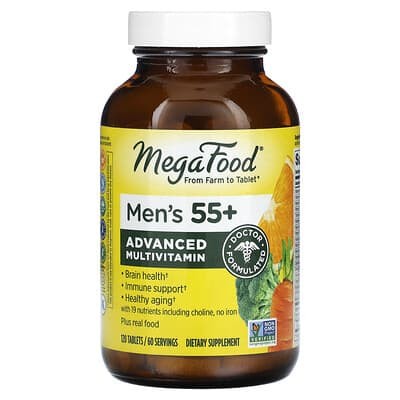
Product Image

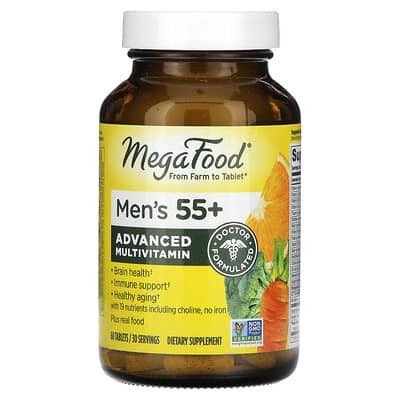
Multi for Men 55+

MegaFood
4.8
★ ★ ★ ★ ★
(1138 ratings)
Molybdenum 55 mcg
Choline 200 mg
Biotin 300 mcg
Chromium 120 mcg
Green Tea 125 mg
Product Image
Score75
A refined older-men's multi with active B vitamins, D3, choline, zinc, green tea, and pumpkin seed. Low selenium and copper beside zinc weaken mineral balance.
How scoring works
Quantity:60 Tablet(s) • (30 servings)
Goals:
Detoxification

Score 75

A refined older-men's multi with active B vitamins, D3, choline, zinc, green tea, and pumpkin seed. Low selenium and copper beside zinc weaken mineral balance.
How scoring works
$26.99($0.89 per serving)
Vitacost
$ 28.73
Pure Formulas
$ 26.99
iHerb
$ 26.99
Report prices

Analysis

The two-tablet serving uses L-5-MTHF, methylcobalamin, P-5-P, active riboflavin, zinc bisglycinate, vitamin D3, and natural vitamin E. Two hundred milligrams of choline plus green-tea and pumpkin-seed extracts add practical depth.

Most vitamin choices are strong, but selenium is only 7.5 mcg and copper only 0.2 mg beside 15 mg zinc. Calcium and magnesium are not meaningfully covered, so the product is not a complete mineral formula.

The iron-free design suits many men over fifty seeking refined vitamin support. Long-term users should pay attention to zinc, copper, selenium, and major-mineral intake from food or other supplements.

Who is it for
  • Men over fifty seeking active vitamin forms
  • Adults who prefer an iron-free multivitamin
  • Users interested in choline and pumpkin-seed support
Best for
  • Refined daily vitamin coverage
  • Active folate and B12 support
  • Iron-free nutrition for older men

Pros

  • Uses active folate, B12, B6, and riboflavin
  • Provides 200 mg choline
  • Includes vitamin D3 and natural vitamin E
  • Uses zinc bisglycinate
  • Adds green-tea and pumpkin-seed extracts

Cons

  • Selenium amount is very low
  • Copper is modest relative to zinc
  • Does not meaningfully cover calcium or magnesium
  • Requires two tablets

Warnings

  • Fifteen milligrams of zinc with low copper should not be stacked long term without reviewing total mineral balance.
  • Green-tea extract may not suit caffeine-sensitive users if residual caffeine is present but undisclosed.
  • Chromium may add to the effect of glucose-lowering medicines and requires monitored use in treated diabetes.

Nutrient quality

84 Highest impact

Active vitamin forms, chelated minerals, and meaningful choline create a strong foundation. Duplicate form entries and selective mineral coverage modestly limit balance.

.
Ingredient transparency

69 High impact

Most ingredients have clear names, forms, and amounts without hidden blends. Repeated form entries and missing usage and excipient details leave some ambiguity.

.

Customer satisfaction

71 High impact

Aggregate satisfaction is very strong and supported by an extensive evidence base. No firsthand experience details are supplied, so recurring complaints and purpose alignment cannot be checked.

.

Value for money

76 High impact

Useful core ingredients provide fair value despite some trade-offs. The package remains reasonably competitive.

.

Report analysis

Goals

Detoxification
Impact
High effect
C+ Goal FitB- Strength of SupportC+ CoverageB- Formula Quality
Folate · 340 mcg DFEVitamin B12 · 20 mcgVitamin B6 · 6 mgMolybdenum · 55 mcgSelenium · 7.5 mcgVitamin E · 15 mgZinc · 15 mgVitamin C · 100 mgCholine · 200 mgRiboflavin · 3.5 mg

Choline, molybdenum, vitamin C, and green tea provide several forms of foundational liver and antioxidant support. The formula is a broad multivitamin rather than a dedicated liver-support product, so it lacks concentrated NAC, milk thistle, or binding fiber.

Clearly listed nutrient amounts allow useful assessment, while the many supportive cofactors offer more breadth than depth. Green tea may be unsuitable for people sensitive to caffeine if its caffeine content is not stated.

Study evidence
Choline Supportive 6 studies
Green Tea Disputed 16 studies
Molybdenum Adverse 1 study
Vitamin C Supportive 9 studies

Ingredients

IngredientAmount per serving
Vitamin A (Beta Carotene)
525 mcg RAE
Vitamin C (Ascorbic Acid)
100 mg
Vitamin D3
25 mcg
Vitamin E (D-Alpha-Tocopherol)
15 mg
Thiamin (Thiamine Hydrochloride)
2.5 mg
Riboflavin (Riboflavin 5'-Phosphate Sodium)
3.5 mg
Niacin (Niacinamide)
20 mg NE
Vitamin B6 (Pyridoxal-5-Phosphate)
6 mg
Folate (L-5-Methyltetrahydrofolate)
340 mcg DFE
Vitamin B12 (Methylcobalamin)
20 mcg
Biotin
300 mcg
Pantothenic Acid (Calcium D-Pantothenate)
8 mg
Choline (Choline Bitartrate)
200 mg
Zinc (Zinc Bisglycinate)
15 mg
Selenium (fermented Selenium Glycinate)
7.5 mcg
Copper (Copper Bisglycinate)
0.2 mg
Manganese (fermented Manganese Bisglycinate)
1 mg
GTF Chromium (Chromium Glutamate, Chromium Nicotinate, fermented Chromium Glycinate)
120 mcg
Molybdenum (fermented Molybdenum Bisglycinate)
55 mcg
Green Tea leaf extract
125 mg
Pumpkin seed extract
125 mg
Men 50+ Gluten Free Kosher Dairy Free Vegetarian
Report overview
A- Active Ingredient Quality & BioavailabilityC Dose, Safety & Label TransparencyD+ Value

The fermented bisglycinate form is a well-defined option with good absorption potential. The amount falls below the collection target, though it stays safely below the adult upper limit. Its serving cost is on the high side for the molybdenum delivered, with much of the formula's value coming from other nutrients and botanicals.

C+ Active Ingredient Quality & BioavailabilityB Dose, Safety & Label TransparencyF Value

The bitartrate source is adequate for general choline intake but less aligned with focused cognitive support. Its moderate elemental dose is stated clearly and split across two tablets. The cost is high for the delivered choline, and the added botanicals do not improve choline-specific value.

Biotin · 300 mcg OverallScore56
B- Active Ingredient Quality & BioavailabilityF Dose, Safety & Label TransparencyC Value

The label lists biotin without confirming that it is the biologically active d-biotin isomer. The 300 mcg serving is below the targeted range commonly used for visible hair and nail support. Biotin is listed as a standalone ingredient with an exact 300 mcg amount, while the broader formula makes a biotin-only cost comparison less meaningful.

Loading alternative details
Report alternatives

Sources

Published studies used for the product analysis and the top-ranked studies for each ingredient and goal.

  1. Choline and contribution to normal liver function of the foetus and exclusively breastfed infants: evaluation of a health claim pursuant to Article 14 of Regulation (EC) No 1924/2006.
    EFSA Panel on Nutrition, Novel Foods and Food allergens (NDA); Turck D; Bohn T; Castenmiller J; De Henauw S; Hirsch-Ernst KI; Knutsen HK; Maciuk A; Mangelsdorf I; McArdle HJ; Naska A; Pentieva K; Thies F; Tsabouri S; Vinceti M; Bresson JL; Fiolet T; Siani A · EFSA journal. European Food Safety Authority · 2024
    Guideline / consensusDetoxification forCholine
  2. Adiposity May Moderate the Link Between Choline Intake and Non-alcoholic Fatty Liver Disease.
    Mazidi M; Katsiki N; Mikhailidis DP; Banach M · Journal of the American College of Nutrition · 2020
    Cross-sectional study20,643 participantsDetoxification forCholine
  3. Choline and Choline-Related Metabolites in Pediatric Short Bowel Syndrome.
    Hilberath J; Shunova A; Heister L; Poets CF; Bernhard W · Nutrients · 2026
    Observational study80 participantsDetoxification forCholine
  4. Choline Supplementation in Cystic Fibrosis-The Metabolic and Clinical Impact.
    Bernhard W; Lange R; Graepler-Mainka U; Engel C; Machann J; Hund V; Shunova A; Hector A; Riethmüller J · Nutrients · 2019
    Single-arm trial10 participantsDetoxification forCholine
  5. 1H MR Spectroscopy at 3T for Hepatic Choline Quantification in Healthy Young Women: A Translational Imaging Study with Dietary Correlation.
    Hawesa H; Alghamdi R; Allam H; Alfaifi B; Alrabiah N; Alghumaiz M; Shanawani M; Alshegri H; Hassan MG · Current medical imaging · 2026
    Cohort study88 participantsDetoxification forCholine
  6. Therapeutic benefits of green tea extract on various parameters in non-alcoholic fatty liver disease patients.
    Hussain M; Habib-Ur-Rehman; Akhtar L · Pakistan journal of medical sciences · 2024
    Randomized trial80 participantsDetoxification forGreen Tea
  7. The Effect of Green Tea Extract Supplementation on Liver Enzymes in Patients with Nonalcoholic Fatty Liver Disease.
    Pezeshki A; Safi S; Feizi A; Askari G; Karami F · International journal of preventive medicine · 2016
    Randomized trial80 participantsDetoxification forGreen Tea
  8. Green tea with high-density catechins improves liver function and fat infiltration in non-alcoholic fatty liver disease (NAFLD) patients: a double-blind placebo-controlled study.
    Sakata R; Nakamura T; Torimura T; Ueno T; Sata M · International journal of molecular medicine · 2014
    Randomized trial17 participantsDetoxification forGreen Tea
  9. Green tea consumption is associated with decreased DNA damage among GSTM1-positive smokers regardless of their hOGG1 genotype.
    Hakim IA; Chow HH; Harris RB · The Journal of nutrition · 2008
    Randomized trialDetoxification forGreen Tea
  10. Modulation of human glutathione s-transferases by polyphenon e intervention.
    Chow HH; Hakim IA; Vining DR; Crowell JA; Tome ME; Ranger-Moore J; Cordova CA; Mikhael DM; Briehl MM; Alberts DS · Cancer epidemiology, biomarkers & prevention : a publication of the American Association for Cancer Research, cosponsored by the American Society of Preventive Oncology · 2007
    Single-arm trial42 participantsDetoxification forGreen Tea
  11. Human molybdenum exposure risk in industrial regions of China: New critical effect indicators and reference dose.
    Kuang HX; Li MY; Zeng XW; Chen D; Zhou Y; Zheng T; Xiang MD; Wu QZ; Chen XC; Dong GH; Yu YJ · Ecotoxicology and environmental safety · 2024
    Cross-sectional study2,267 participantsDetoxification forMolybdenum
  12. Vitamin C supplementation ameliorates liver function profile and antiviral treatment response in Hepatitis C patients.
    Nayila I; Javed MS; Khan MA; Hussain G; Raza Naqvi SA; Ali S; Jabeen Z; Shahnawaz S; Akram R; Iman T; Hassan Dogar MZ; Malik SA · Pakistan journal of pharmaceutical sciences · 2022
    Non-randomized trial200 participantsDetoxification forVitamin C
  13. Effect of ascorbic acid-rich diet on in vivo-induced oxidative stress.
    Alleva R; Di Donato F; Strafella E; Staffolani S; Nocchi L; Borghi B; Pignotti E; Santarelli L; Tomasetti M · The British journal of nutrition · 2012
    Non-randomized trial46 participantsDetoxification forVitamin C
  14. Dietary Vitamin C Intake Is Associated With Improved Liver Function and Glucose Metabolism in Chinese Adults.
    Luo X; Zhang W; He Z; Yang H; Gao J; Wu P; Ma ZF · Frontiers in nutrition · 2022
    Observational study8,307 participantsDetoxification forVitamin C
  15. Plasma ascorbate deficiency is associated with impaired reduction of sulfamethoxazole-nitroso in HIV infection.
    Trepanier LA; Yoder AR; Bajad S; Beckwith MD; Bellehumeur JL; Graziano FM · Journal of acquired immune deficiency syndromes (1999) · 2005
    Observational studyDetoxification forVitamin C
  16. Roles of endogenous ascorbate and glutathione in the cellular reduction and cytotoxicity of sulfamethoxazole-nitroso.
    Lavergne SN; Kurian JR; Bajad SU; Maki JE; Yoder AR; Guzinski MV; Graziano FM; Trepanier LA · Toxicology · 2006
    Clinical trial53 participantsDetoxification forVitamin C