Product Image

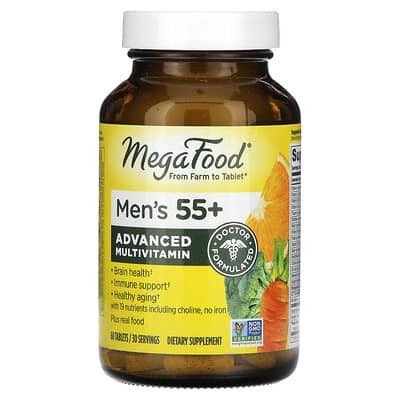
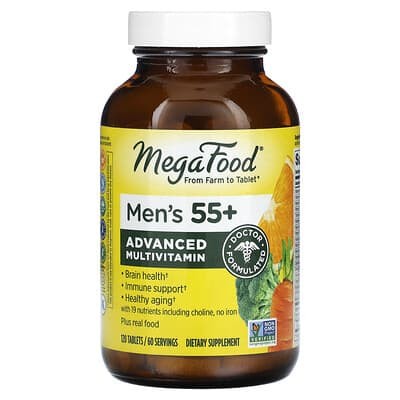
Multi for Men 55+

MegaFood
4.7
★ ★ ★ ★ ★
(2594 ratings)
Molybdenum 55 mcg
Choline 200 mg
Biotin 300 mcg
Chromium 120 mcg
Green Tea 125 mg
Product Image
Score76
A strong active-form, iron-free multi for older men with useful choline and botanical extracts. Low selenium and copper remain notable weaknesses despite the larger supply.
How scoring works
Quantity:120 Tablet(s) • (60 servings)
Goals:
Detoxification

Score 76

A strong active-form, iron-free multi for older men with useful choline and botanical extracts. Low selenium and copper remain notable weaknesses despite the larger supply.
How scoring works
$50.99($0.84 per serving)
iHerb
$ 50.99
Amazon
$ 50.99
Vitacost
$ 53.43
Report prices

Analysis

The formula uses L-5-MTHF, methylcobalamin, P-5-P, active riboflavin, zinc bisglycinate, vitamin D3, and natural vitamin E. Choline at 200 mg plus green-tea and pumpkin-seed extracts provide meaningful extras for a general multivitamin.

Selenium is only 7.5 mcg and copper only 0.2 mg beside 15 mg zinc. Calcium and magnesium are also absent from meaningful coverage, leaving several common mineral needs to diet.

The larger bottle improves convenience and ongoing value for men over fifty who do not need iron. It remains important to review mineral balance if the product is combined with other zinc-containing supplements.

Who is it for
  • Men over fifty wanting a longer supply
  • Adults seeking active B-vitamin forms without iron
  • Users interested in choline and pumpkin seed
Best for
  • Longer-term daily vitamin coverage
  • Active folate and B12 support
  • Iron-free older-men's nutrition

Pros

  • Uses active folate, B12, B6, and riboflavin
  • Provides 200 mg choline
  • Includes vitamin D3 and natural vitamin E
  • Uses zinc bisglycinate
  • Larger supply improves ongoing convenience

Cons

  • Selenium is unusually low
  • Copper is modest relative to zinc
  • Does not cover calcium or magnesium
  • Requires two tablets

Warnings

  • Fifteen milligrams of zinc with low copper should not be stacked long term without reviewing total mineral balance.
  • Green-tea extract may not suit caffeine-sensitive users if residual caffeine is present but undisclosed.
  • Chromium may add to the effect of glucose-lowering medicines and requires monitored use in treated diabetes.

Nutrient quality

84 Highest impact

Active vitamin forms, chelated minerals, and meaningful choline create a strong foundation. Duplicate form entries and selective mineral coverage modestly limit balance.

.
Ingredient transparency

69 High impact

Most ingredients have clear names, forms, and amounts without hidden blends. Repeated form entries and missing usage and excipient details leave some ambiguity.

.

Customer satisfaction

71 High impact

Aggregate satisfaction is strong and supported by an extensive evidence base. No firsthand experience details are supplied, so recurring complaints and purpose alignment cannot be checked.

.

Value for money

79 High impact

Useful ingredients and a sound category position support good value. The package remains reasonably competitive.

.

Report analysis

Goals

Detoxification
Impact
High effect
B- Goal FitB Strength of SupportB- CoverageC+ Formula Quality
Folate · 340 mcg DFEVitamin B12 · 20 mcgVitamin B6 · 6 mgMolybdenum · 55 mcgSelenium · 7.5 mcgVitamin E · 15 mgZinc · 15 mgVitamin C · 100 mgCholine · 200 mgRiboflavin · 3.5 mg

Molybdenum, choline, selenium, green tea, and activated B vitamins support several clearance-related pathways. The blend remains a broad multivitamin rather than a dedicated liver formula.

Good forms and clear amounts strengthen its foundational value. Individual detoxification pathways receive only moderate depth, and many ingredients serve other goals.

Study evidence
Choline Supportive 6 studies
Green Tea Disputed 16 studies
Molybdenum Adverse 1 study
Selenium Supportive 10 studies
Zinc Supportive 30 studies

Ingredients

IngredientAmount per serving
Vitamin A (Beta Carotene)
525 mcg RAE
Vitamin C (Ascorbic Acid)
100 mg
Vitamin D3 (Cholecalciferol)
25 mcg
Vitamin E (D-Alpha-Tocopherol)
15 mg
Thiamin (Thiamine Hydrochloride)
2.5 mg
Riboflavin (Riboflavin 5'-Phosphate Sodium)
3.5 mg
Niacin (Niacinamide, S. cerevisiae)
20 mg NE
Vitamin B6 (Pyridoxal-5-Phosphate)
6 mg
Folate (L-5-Methyltetrahydrofolate)
340 mcg DFE
Vitamin B12 (Methylcobalamin)
20 mcg
Biotin
300 mcg
Pantothenic Acid (Calcium D-Pantothenate)
8 mg
Choline (Choline Bitartrate)
200 mg
Zinc (Zinc Bisglycinate)
15 mg
Selenium (Selenium Glycinate)
7.5 mcg
Copper (Copper Bisglycinate)
0.2 mg
Manganese (Manganese Bisglycinate)
1 mg
Chromium (Chromium Glutamate, Chromium Glycinate, Chromium Nicotinate)
120 mcg
Molybdenum (Molybdenum Bisglycinate)
55 mcg
Green Tea Leaf Extract
125 mg
Pumpkin seed extract
125 mg
Men 50+ Gluten Free Kosher Dairy Free Vegetarian
Report overview
A- Active Ingredient Quality & BioavailabilityC Dose, Safety & Label TransparencyD+ Value

Molybdenum bisglycinate offers a clearly identified form with good absorption potential. The amount is below the collection target but stays well within the adult safety limit. The serving cost is high for the molybdenum provided, so the formula makes more sense as a broad multivitamin than as a focused source.

C+ Active Ingredient Quality & BioavailabilityB Dose, Safety & Label TransparencyF Value

The standard bitartrate source can support general intake but offers limited advantages for cognitive targeting. The moderate elemental amount is transparent and delivered in two tablets. Despite a somewhat lower serving cost, the choline-specific value remains poor for a basic form.

Biotin · 300 mcg OverallScore56
B- Active Ingredient Quality & BioavailabilityF Dose, Safety & Label TransparencyC Value

The label lists biotin without confirming that it is the biologically active d-biotin isomer. The 300 mcg serving is below the targeted range commonly used for visible hair and nail support. Biotin is listed as a standalone ingredient with an exact 300 mcg amount, while the broader formula makes a biotin-only cost comparison less meaningful.

Loading alternative details
Report alternatives

Sources

Published studies used for the product analysis and the top-ranked studies for each ingredient and goal.

  1. Choline and contribution to normal liver function of the foetus and exclusively breastfed infants: evaluation of a health claim pursuant to Article 14 of Regulation (EC) No 1924/2006.
    EFSA Panel on Nutrition, Novel Foods and Food allergens (NDA); Turck D; Bohn T; Castenmiller J; De Henauw S; Hirsch-Ernst KI; Knutsen HK; Maciuk A; Mangelsdorf I; McArdle HJ; Naska A; Pentieva K; Thies F; Tsabouri S; Vinceti M; Bresson JL; Fiolet T; Siani A · EFSA journal. European Food Safety Authority · 2024
    Guideline / consensusDetoxification forCholine
  2. Adiposity May Moderate the Link Between Choline Intake and Non-alcoholic Fatty Liver Disease.
    Mazidi M; Katsiki N; Mikhailidis DP; Banach M · Journal of the American College of Nutrition · 2020
    Cross-sectional study20,643 participantsDetoxification forCholine
  3. Choline and Choline-Related Metabolites in Pediatric Short Bowel Syndrome.
    Hilberath J; Shunova A; Heister L; Poets CF; Bernhard W · Nutrients · 2026
    Observational study80 participantsDetoxification forCholine
  4. Choline Supplementation in Cystic Fibrosis-The Metabolic and Clinical Impact.
    Bernhard W; Lange R; Graepler-Mainka U; Engel C; Machann J; Hund V; Shunova A; Hector A; Riethmüller J · Nutrients · 2019
    Single-arm trial10 participantsDetoxification forCholine
  5. 1H MR Spectroscopy at 3T for Hepatic Choline Quantification in Healthy Young Women: A Translational Imaging Study with Dietary Correlation.
    Hawesa H; Alghamdi R; Allam H; Alfaifi B; Alrabiah N; Alghumaiz M; Shanawani M; Alshegri H; Hassan MG · Current medical imaging · 2026
    Cohort study88 participantsDetoxification forCholine
  6. Therapeutic benefits of green tea extract on various parameters in non-alcoholic fatty liver disease patients.
    Hussain M; Habib-Ur-Rehman; Akhtar L · Pakistan journal of medical sciences · 2024
    Randomized trial80 participantsDetoxification forGreen Tea
  7. The Effect of Green Tea Extract Supplementation on Liver Enzymes in Patients with Nonalcoholic Fatty Liver Disease.
    Pezeshki A; Safi S; Feizi A; Askari G; Karami F · International journal of preventive medicine · 2016
    Randomized trial80 participantsDetoxification forGreen Tea
  8. Green tea with high-density catechins improves liver function and fat infiltration in non-alcoholic fatty liver disease (NAFLD) patients: a double-blind placebo-controlled study.
    Sakata R; Nakamura T; Torimura T; Ueno T; Sata M · International journal of molecular medicine · 2014
    Randomized trial17 participantsDetoxification forGreen Tea
  9. Green tea consumption is associated with decreased DNA damage among GSTM1-positive smokers regardless of their hOGG1 genotype.
    Hakim IA; Chow HH; Harris RB · The Journal of nutrition · 2008
    Randomized trialDetoxification forGreen Tea
  10. Modulation of human glutathione s-transferases by polyphenon e intervention.
    Chow HH; Hakim IA; Vining DR; Crowell JA; Tome ME; Ranger-Moore J; Cordova CA; Mikhael DM; Briehl MM; Alberts DS · Cancer epidemiology, biomarkers & prevention : a publication of the American Association for Cancer Research, cosponsored by the American Society of Preventive Oncology · 2007
    Single-arm trial42 participantsDetoxification forGreen Tea
  11. Human molybdenum exposure risk in industrial regions of China: New critical effect indicators and reference dose.
    Kuang HX; Li MY; Zeng XW; Chen D; Zhou Y; Zheng T; Xiang MD; Wu QZ; Chen XC; Dong GH; Yu YJ · Ecotoxicology and environmental safety · 2024
    Cross-sectional study2,267 participantsDetoxification forMolybdenum
  12. Supplementation with selenium can influence nausea, fatigue, physical, renal, and liver function of children and adolescents with cancer.
    Vieira ML; Fonseca FL; Costa LG; Beltrame RL; Chaves CM; Cartum J; Alves SI; Azzalis LA; Junqueira VB; Pereria EC; Rocha KC · Journal of medicinal food · 2015
    Randomized trialDetoxification forSelenium
  13. [Selenium and oxidative stress in cancer patients].
    Gorozhanskaia ÉG; Sviridova SP; Dobrovol'skaia MM; Zybrikhina GN; Kashnia ShR · Biomeditsinskaia khimiia · 2014
    Single-arm trial40 participantsDetoxification forSelenium
  14. Comprehensive Insights into the Health Effects of Selenium Exposure and Supplementation Among the Chinese Community Middle-Aged and Elderly: a Combined Retrospective Cohort Study and Intervention Study.
    Li C; Peng X; Zheng J; Shi K; Qin L; Yang Q; Wang Z; Liu Y; Huang L · Biological trace element research · 2024
    Other40 participantsDetoxification forSelenium
  15. Heavy metals and metalloids exposure and liver function in Chinese adults - A nationally representative cross-sectional study.
    Wang S; Lyu Y; Ji S; Liu N; Wu B; Zhao F; Li Z; Qu Y; Zhu Y; Xie L; Li Y; Zhang Z; Song H; Hu X; Qiu Y; Zheng X; Zhang W; Yang Y; Li F; Cai J; Zhu Y; Cao Z; Tan F; Shi X · Environmental research · 2024
    Cross-sectional study9,445 participantsDetoxification forSelenium
  16. Selenium-Biofortified Strawberries Improve Glucose Homeostasis and Hepatic Function: A 30-Day Randomized Controlled Trial in Healthy Adults.
    Vasto S; Di Rosa L; Ferrantelli V; Fiore AS; Giordano CP; Cannizzaro A; Sabatino L; Macaluso A; Caldarella R; Caldara GF; Baldassano S · Nutrients · 2026
    Randomized trial35 participantsDetoxification forSelenium
  17. [Therapy of Wilson disease].
    Smolarek C; Stremmel W · Zeitschrift fur Gastroenterologie · 1999
    Narrative reviewDetoxification forZinc
  18. Efficacy of Zinc Supplement in Minimal hepatic Encephalopathy: A prospective, Randomized Controlled Study (Zinc-MHE Trial).
    Janyajirawong R; Vilaichone RK; Sethasine S · Asian Pacific journal of cancer prevention : APJCP · 2021
    Randomized trial69 participantsDetoxification forZinc
  19. Effect of zinc on liver cirrhosis with hyperammonemia: a preliminary randomized, placebo-controlled double-blind trial.
    Katayama K; Saito M; Kawaguchi T; Endo R; Sawara K; Nishiguchi S; Kato A; Kohgo H; Suzuki K; Sakaida I; Ueno Y; Habu D; Ito T; Moriwaki H; Suzuki K · Nutrition (Burbank, Los Angeles County, Calif.) · 2015
    Randomized trial18 participantsDetoxification forZinc
  20. Effects of low dose zinc supplementation on biochemical markers in non-alcoholic cirrhosis: a randomized clinical trial.
    Somi MH; Rezaeifar P; Ostad Rahimi A; Moshrefi B · Archives of Iranian medicine · 2012
    Randomized trial60 participantsDetoxification forZinc
  21. Correlation of Serum Zinc Levels with Hepatic Encephalopathy Severity in Patients with Decompensated Liver Cirrhosis: A Prospective Observational Study from Egypt.
    Semeya AA; Elgamal R; Othman AAA · Biological trace element research · 2025
    Observational study200 participantsDetoxification forZinc