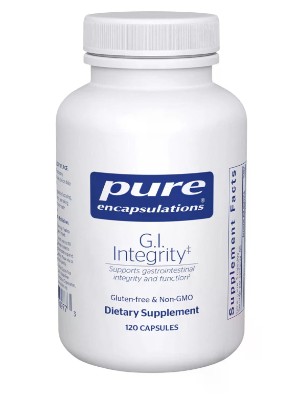

Product Image

G.I. Integrity

Pure Encapsulations
4.8
★ ★ ★ ★ ★
(11 ratings)
N-Acetyl Glucosamine 500 mg
Aloe 50 mg
Glutamine 1000 mg
Product Image
Score76
A focused mix of N-acetyl-D-glucosamine, glutamine, aloe, and gamma oryzanol supports digestive lining needs. Shellfish sourcing and modest glutamine are the main limits.
How scoring works
Quantity:120 Capsule(s) • (60 servings)
Goals:
Digestive Health
Skin Health

Score 76

A focused mix of N-acetyl-D-glucosamine, glutamine, aloe, and gamma oryzanol supports digestive lining needs. Shellfish sourcing and modest glutamine are the main limits.
How scoring works
$48.00($0.80 per serving)
Pure Formulas
$ 48.00
Report prices

Analysis

N-acetyl-D-glucosamine is supplied at a meaningful amount with its active isomer and shellfish sources clearly identified. It provides the strongest barrier-oriented ingredient and also gives the formula some skin-hydration relevance.

L-glutamine at 1 g is useful as a supporting amount but light for a dedicated gut product. Gamma oryzanol and a 50 mg aloe extract broaden the formula, although aloe polysaccharide yield, inner-leaf status, and aloin removal are not confirmed.

Two capsules per serving and reasonable value support regular use. The product fits people seeking a concise gut-lining combination better than those who want a high-dose glutamine supplement or need a shellfish-free option.

Who is it for
  • Adults seeking a concise gut-lining formula
  • People who want clearly sourced N-acetyl-D-glucosamine
  • Users without crab or shrimp allergy
Best for
  • Digestive-lining support
  • N-acetyl-D-glucosamine supplementation
  • Barrier-focused formulas with modest glutamine

Pros

  • Identifies the active N-acetyl-D-glucosamine isomer
  • Clearly discloses crab and shrimp sources
  • Uses a concise four-ingredient formula
  • Requires two capsules per serving

Cons

  • Glutamine is limited to 1 g
  • Aloe purification and aloin removal are not stated
  • Aloe active-polysaccharide yield is unclear
  • Not suitable for shellfish-allergic users

Warnings

  • N-acetyl-D-glucosamine is derived from crab and shrimp and is unsuitable for people with those shellfish allergies.
  • Aloe purification and aloin removal are not verified, leaving laxative-compound exposure uncertain.
  • The shellfish-derived ingredient should be reviewed before use by anyone with a history of severe shellfish reactions.

Nutrient quality

84 Highest impact

The biologically relevant glucosamine isomer and shellfish sources are clearly identified; n-acetyl-D-glucosamine is substantial, while glutamine and aloe are more modest. The doses are balanced, but the shellfish-derived ingredient is unsuitable for people with crab or shrimp allergy; the ingredients form a concise digestive-support combination; the short formula avoids obvious low-value padding.

.


Ingredient transparency

78 High impact

Every listed active has a specific amount; no proprietary blend hides key doses. Specific isomer and source naming make the major ingredients easy to evaluate; serving directions and inactive ingredients are not included in the supplied details.

.

Customer satisfaction

60 Moderate impact

The supplied aggregate average is very favorable, though no individual feedback is available; the small rating sample limits confidence, and no individual feedback is supplied. Detailed feedback is absent, so repeated complaints cannot be assessed; real-world fit with the intended purpose remains uncertain.

.

Value for money

79 High impact

Focused ingredient quality supports the midrange positioning; the serving offers reasonable value for a concise combination formula. Few ingredients appear unnecessary or decorative; the product compares favorably with many premium digestive blends.

.
Report analysis

Goals

Digestive Health
Impact
High effect
B+ Goal FitB- Strength of SupportB- CoverageA Formula Quality
Glutamine · 1000 mgN-Acetyl Glucosamine · 500 mg

L-glutamine, N-acetyl-D-glucosamine, aloe, and gamma oryzanol form a focused gut-lining support formula. The glucosamine isomer and amount are well disclosed, while the ingredients serve complementary barrier roles.

The glutamine amount is modest for targeted gut use and aloe purification details are missing. N-acetyl-D-glucosamine is derived from crab and shrimp, making the formula unsuitable for people with relevant shellfish allergy.

Study evidence
Aloe Supportive 7 studies
Glutamine Supportive 37 studies
Skin Health
Impact
High effect
B- Goal FitA- Strength of SupportC+ CoverageB- Formula Quality
N-Acetyl Glucosamine · 500 mg

N-acetyl-D-glucosamine provides direct relevance as a precursor involved in hyaluronic acid biology. A meaningful amount supports hydration-related potential, but skin-specific oral evidence is less established than for leading actives.

The active isomer, amount, and shellfish sources are clearly disclosed in a concise formula. People with crab or shrimp allergy should avoid it because both shellfish sources are named.

Study evidence
N-Acetyl Glucosamine Supportive 7 studies

Ingredients

IngredientAmount per serving
L-Glutamine
1000 mg
N-Acetyl-D-Glucosamine (Crab, Shrimp)
500 mg
Gamma Oryzanol (Rice Bran)
150 mg
Aloe vera (Aloe barbadensis) extract (Polysaccharides)
50 mg
Gluten Free Adults 18–50
Report overview
A- Active Ingredient Quality & BioavailabilityA- Dose, Safety & Label TransparencyA Value

N-Acetyl-D-glucosamine clearly identifies the biologically relevant isomer and provides a standard therapeutic amount. The shellfish source is transparent, but people with crab or shrimp allergy should avoid this formula because both sources are named. L-glutamine, gamma oryzanol, and aloe broaden digestive support and improve the value of the combination.

F Active Ingredient Quality & BioavailabilityA+ Dose, Safety & Label TransparencyD- Value

The aloe source does not confirm purified inner-leaf material or aloin removal; the extract lacks a concentration ratio or defined polysaccharide standardization. The disclosed 50 mg extract serving meets the meaningful-dose threshold for concentrated aloe. Cost per serving is above the collection median; glutamine and N-acetyl-D-glucosamine add broader formula value.

Glutamine · 1000 mg OverallScore58
B- Active Ingredient Quality & BioavailabilityC Dose, Safety & Label TransparencyF Value

The glutamine amount is modest, and reaching a more useful intake requires several capsules. Aloe, gamma oryzanol, and N-acetyl-D-glucosamine broaden the gut-focused formula, but glutamine-specific value is poor. The crab- and shrimp-derived N-acetyl-D-glucosamine may be unsuitable for people with shellfish allergy.

Loading alternative details
Report alternatives

Sources

Published studies used for the product analysis and the top-ranked studies for each ingredient and goal.

  1. The effect of N-acetyl-glucosamine on stratum corneum desquamation and water content in human skin.
    Mammone T; Gan D; Fthenakis C; Marenus K · Journal of cosmetic science · 2009
    Clinical trialSkin Health forN-Acetyl Glucosamine
  2. Reduction in the appearance of facial hyperpigmentation by topical N-acetyl glucosamine.
    Bissett DL; Robinson LR; Raleigh PS; Miyamoto K; Hakozaki T; Li J; Kelm GR · Journal of cosmetic dermatology · 2007
    Randomized trial50 participantsSkin Health forN-Acetyl Glucosamine
  3. A Pilot Study of the Effect of Aloe barbadensis Mill. Extract (AVH200®) in Patients with Irritable Bowel Syndrome: a Randomized, Double-Blind, Placebo-Controlled Study.
    Størsrud S; Pontén I; Simrén M · Journal of gastrointestinal and liver diseases : JGLD · 2016
    Randomized trial68 participantsDigestive Health forAloe
  4. A Randomised, Cross-Over, Placebo-Controlled Study of Aloe vera in Patients with Irritable Bowel Syndrome: Effects on Patient Quality of Life.
    Hutchings HA; Wareham K; Baxter JN; Atherton P; Kingham JG; Duane P; Thomas L; Thomas M; Ch'ng CL; Williams JG · ISRN gastroenterology · 2011
    Randomized trial110 participantsDigestive Health forAloe
  5. Improvement of intestinal permeability with alanyl-glutamine in HIV patients: a randomized, double blinded, placebo-controlled clinical trial.
    Leite RD; Lima NL; Leite CA; Farhat CK; Guerrant RL; Lima AA · Arquivos de gastroenterologia · 2013
    Randomized trial46 participantsDigestive Health forGlutamine
  6. Treatment of acute diarrhea with oral rehydration solutions containing glutamine.
    Ribeiro Júnior H; Ribeiro T; Mattos A; Palmeira C; Fernandez D; Sant'Ana I; Rodrigues I; Bendicho MT; Fontaine O · Journal of the American College of Nutrition · 1994
    Randomized trial120 participantsDigestive Health forGlutamine
  7. Prevention of acute radiation-induced Proctitis by Aloe vera: a prospective randomized, double-blind, placebo controlled clinical trial in Pelvic Cancer patients.
    Sahebnasagh A; Ghasemi A; Akbari J; Alipour A; Lashkardoost H; Ala S; Hosseinimehr SJ; Salehifar E · BMC complementary medicine and therapies · 2020
    Randomized trial42 participantsDigestive Health forAloe
  8. Successful Treatment of Acute Radiation Proctitis with Aloe Vera: A Preliminary Randomized Controlled Clinical Trial.
    Sahebnasagh A; Ghasemi A; Akbari J; Alipour A; Lashkardoost H; Ala S; Salehifar E · Journal of alternative and complementary medicine (New York, N.Y.) · 2017
    Randomized trial20 participantsDigestive Health forAloe
  9. Aloe vera for Prevention of Acute Radiation Proctitis in Colorectal Cancer a Preliminary Randomized, Placebo-Controlled Clinical Trial.
    Sahebnasagh A; Saghafi F; Ghasemi A; Akbari J; Alipour A; Habtemariam S; Safdari M; Ghaleno HR; Salehifar E · Journal of gastrointestinal cancer · 2022
    Randomized trial20 participantsDigestive Health forAloe
  10. Effect of perioperative glutamine-enriched nutritional support on patients with colorectal cancer: A systematic review and meta-analysis.
    Huang Y; Yang XZ; Qin SH; Zhang T; Xie M; Wang JW · World journal of gastrointestinal surgery · 2026
    Meta-analysis1,643 participants27 studies pooledDigestive Health forGlutamine
  11. Glutamine prevents diarrhea in colorectal cancer patients undergoing chemotherapy or chemoradiotherapy: a meta-analysis.
    Chen L; Wang D; Meng C; Sun H; Li R; Miao G; Liu P · BMC gastroenterology · 2025
    Meta-analysis311 participants5 studies pooledDigestive Health forGlutamine
  12. Glutamine supplementation reduces markers of intestinal permeability during running in the heat in a dose-dependent manner.
    Pugh JN; Sage S; Hutson M; Doran DA; Fleming SC; Highton J; Morton JP; Close GL · European journal of applied physiology · 2018
    Randomized trial10 participantsDigestive Health forGlutamine
  13. Effect of glutamine supplementation on diarrhea, interleukin-8 and secretory immunoglobulin A in children with acute diarrhea.
    Yalçin SS; Yurdakök K; Tezcan I; Oner L · Journal of pediatric gastroenterology and nutrition · 2004
    Randomized trial128 participantsDigestive Health forGlutamine
  14. A randomized, investigator-blinded, controlled pilot study to evaluate the safety and efficacy of a poly-N-acetyl glucosamine-derived membrane material in patients with venous leg ulcers.
    Kelechi TJ; Mueller M; Hankin CS; Bronstone A; Samies J; Bonham PA · Journal of the American Academy of Dermatology · 2012
    Randomized trial82 participantsSkin Health forN-Acetyl Glucosamine
  15. Poly-N-acetyl glucosamine nanofibers for negative-pressure wound therapies.
    Fulco I; Erba P; Valeri RC; Vournakis J; Schaefer DJ · Wound repair and regeneration : official publication of the Wound Healing Society [and] the European Tissue Repair Society · 2016
    Randomized trial20 participantsSkin Health forN-Acetyl Glucosamine
  16. Preparation, characterization, and moisturizing effect of liposomes containing glucosamine and N-acetyl glucosamine.
    Malaekeh-Nikouei B; Golmohammadzadeh S; Salmani-Chamanabad S; Mosallaei N; Jamialahmadi K · Journal of cosmetic dermatology · 2014
    Clinical trialSkin Health forN-Acetyl Glucosamine