
Nutrient quality
Well-regarded mineral forms and useful potassium and magnesium support routine hydration. Modest sodium and chloride plus token trace-mineral amounts limit performance during heavy sweating.
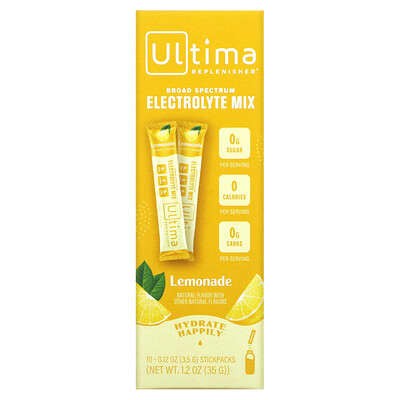
.
 iHerb iHerb | $ 8.05 | |
 Amazon Amazon | $ 11.43 |
The formula combines potassium, magnesium, phosphorus, calcium, and chloride in generally useful forms. Zero sugar makes it suitable for people who want flavor and minerals without added carbohydrate.
Potassium and magnesium provide useful everyday support, but sodium and chloride are modest for replacing large sweat losses. The broad trace-mineral list adds range, though several entries are present in very small amounts.
Single-serve packets are convenient for travel or occasional use. That convenience comes with weaker routine value than larger tubs of the same basic formula.
Well-regarded mineral forms and useful potassium and magnesium support routine hydration. Modest sodium and chloride plus token trace-mineral amounts limit performance during heavy sweating.
.All listed active amounts are visible and no proprietary blend hides the electrolyte doses. Complete directions and inactive ingredients are missing, while duplicate source entries can be confusing.
.The aggregate rating indicates favorable customer satisfaction. Substantial feedback volume supports the aggregate, but no review details are available.
.Portable packets and useful mineral forms support convenience value. The higher serving cost and modest sodium and chloride reduce competitiveness for regular hydration.
.
Potassium and magnesium support hydration, vascular tone, and normal cardiac electrical function. Their amounts are modest, making the packet more useful for light electrolyte replacement than targeted cardiovascular support.
Named citrate, aspartate, phosphate, and chloride forms make the electrolyte profile transparent. Potassium can accumulate dangerously in kidney disease or with ACE inhibitors, ARBs, or potassium-sparing diuretics.
| Ingredient | Amount per serving |
|---|---|
Calories | 0 Calorie(s) |
Total Carbohydrates | 0 Gram(s) |
Sugar | 0 Gram(s) |
Vitamin C (Calcium Ascorbate) | 100 mg |
Calcium (Calcium Ascorbate, Calcium Citrate) | 65 mg |
Phosphorus (Potassium Phosphate) | 70 mg |
Magnesium (Magnesium Citrate) | 100 mg |
Zinc (Zinc Citrate) | 1 mg |
Selenium (Selenium Amino Acid Chelate) | 1.25 mcg |
Copper (Copper Citrate) | 0.2 mg |
Manganese (Manganese Citrate) | 0.2 mg |
Chromium (Chromium Nicotinate Glycinate Chelate) | 5 mcg |
Molybdenum (Sodium Molybdate) | 3.5 mcg |
Chloride (Sodium Chloride) | 79 mg |
Sodium (Sodium Chloride) | 55 mg |
Potassium (Potassium Aspartate, Potassium Phosphate) | 250 mg |
Potassium phosphate provides a clearly identified phosphorus source, although it is more aligned with electrolyte use than bone structure. The elemental dose is explicit and easy to take in one packet. Its per-serving cost falls into a less competitive tier.
Potassium aspartate adds a highly bioavailable organic form, while potassium phosphate offers basic electrolyte support. The 250 mg label amount is moderate, but separate compound weights and elemental yield are not shown. Its sub-median serving cost is reasonable, though the dose falls short of the collection's effective threshold.
Sodium chloride provides a standard, clearly identified source in a drink mix. The chloride amount sits near the collection median, supporting general hydration rather than high-potency replenishment. Serving cost is in the average range.
Published studies used for the product analysis and the top-ranked studies for each ingredient and goal.