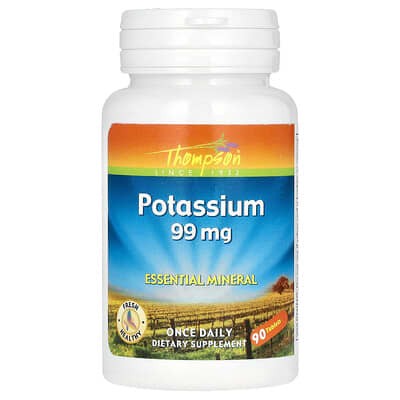
An amino acid potassium complex gives the tablet a focused, absorption-oriented form. At 99 mg, the serving contributes little compared with the amount normally obtained from food.
Potassium is relevant to sodium balance, fluid regulation, and normal cardiac electrical activity. The formula does not address vascular lipids, oxidative stress, or magnesium intake.
A large review count does not provide ingredient-level evidence, so the label remains the basis for assessment. The tablet fits deliberate low-dose use better than correction of a meaningful dietary shortfall.
thumb_upPros
Disclosed amino acid complex
Single active ingredient
Convenient long supply
thumb_downCons
Very small potassium contribution
No broader heart-support ingredients
Compound and elemental weights are not separated
warningWarnings
The 99 mg potassium serving may be unsuitable with impaired kidney function because potassium can accumulate.
ACE inhibitors, ARBs, and potassium-sparing diuretics can increase the risk of excessive blood potassium.
Taking potassium without enough fluid or food may cause stomach irritation in sensitive users.
scienceNutrient quality
78
High impact
A potassium amino acid complex provides an absorption-oriented organic source. The elemental amount is too small to make a substantial contribution to daily potassium intake, while the low amount avoids obvious excess for healthy adults.
scienceIngredient transparency
80
Highest impact
The form and elemental amount are clear, though the exact amino-acid ligand is not named. Serving totals are apparent, but full directions and inactive ingredients are not supplied.
thumb_upCustomer satisfaction
70
High impact
The supplied average rating is strong. A large rating base gives the average good reliability, while complaint and firsthand experience details are unavailable.
workspace_premiumValue for money
93
Highest impact
Formula quality supports the asking position well. The serving value is highly competitive within the category.
B-
Goal FitD+
Strength of SupportF
CoverageA
Formula Quality
An amino acid potassium complex provides a clearly focused electrolyte supplement. Potassium has a direct role in sodium-potassium balance and vascular physiology.
The serving is too small to make a substantial contribution to daily potassium intake. No magnesium or other cardiovascular active broadens the effect.
scienceStudy evidence
SupportiveMixedNo effectAdverse
Potassium Supportive star star_border star_border star_border star_border 182 studies
A+
Active Ingredient Quality & BioavailabilityD
Dose, Safety & Label TransparencyD+
Value
An amino acid complex offers an organic, absorption-oriented potassium source. The 99 mg serving is still too small for substantial potassium support. Its very low serving cost is reasonable for the limited amount supplied.
<p>A clearly labeled 494 mg of potassium bicarbonate provides a meaningful, alkalizing alternative to the original's potassium contribution. The simple powder improves dose clarity, but impaired kidney function or potassium-retaining medicines can make the amount unsafe without guidance.</p>
<p>Potassium citrate supplies a meaningful 448 mg amount in a well-absorbed, alkalizing form. Its focused label gives stronger form and dose clarity than many mixed products, while kidney impairment and potassium-retaining medicines can raise blood potassium too far.</p>
<p>A named Albion amino acid complex provides a clearly identified potassium form for users who prefer a low-dose capsule. The 99 mg amount is far smaller than the higher-dose powder options, so its advantage is form clarity rather than substantial electrolyte delivery.</p>
<p>A clearly quantified 365 mg of potassium chloride makes this a focused, low-cost substitute for the original's potassium component. Chloride supports electrolyte replacement but lacks the buffering role of citrate or bicarbonate, and kidney impairment or potassium-retaining medicines can make supplementation unsafe.</p>
<p>The simple powder provides 365 mg of potassium as chloride with very low recurring cost. It is easier to assess than a broad blend but lacks citrate's buffering role, while kidney impairment or potassium-retaining medicines remain important cautions.</p>
<p>It is not below the original's already low recurring cost, so it serves as a close-value substitute rather than a strictly cheaper option. Aspartate, citrate, and gluconate provide several usable potassium forms at accessible recurring value. The repeated 99 mg source entries make the total less clear, and the serving still appears intended for modest supplementation.</p>
<p>A simple capsule supplies 200 mg of potassium citrate, providing an absorbable and alkalizing form at a moderate amount. It offers a practical middle ground between low-dose tablets and concentrated powders, with the same kidney and medication cautions that apply to added potassium.</p>
<p>A focused powder supplies 175 mg of potassium gluconate with excellent recurring value. The amount is more useful than a basic 99 mg tablet but remains a limited contribution beside dietary needs, and potassium retention from kidney disease or medicines still matters.</p>
<p>Citrate and an amino acid chelate provide useful form quality in a streamlined supplement. Repeated 99 mg entries make the total potassium amount ambiguous, but the low recurring cost supports cautious, modest use.</p>
flagReport alternatives
schoolSources
Published studies used for the product analysis and the top-ranked studies for each ingredient and goal.
Swift SL; Sotres-Alvarez D; Raij L; Wassertheil-Smoller S; Schneiderman N; Llabre M; Zeki Al Hazzouri A; Rundek T; Van Horn L; Daviglus M; Castaneda S; Youngblood M; Mossavar-Rahmani Y; Elfassy T · The American journal of clinical nutrition · 2024
Cohort study11,429 participantsflagHeart Health forsciencePotassium