
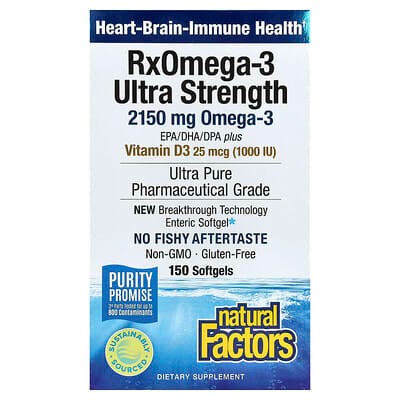
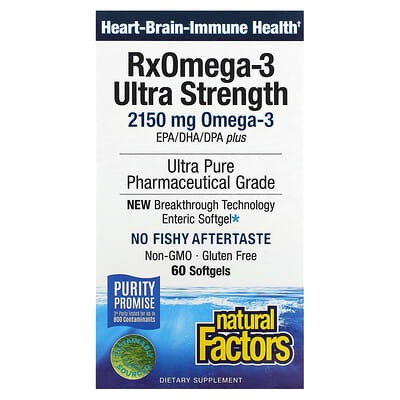
Nutrient quality
The concentrated serving provides substantial omega-fatty-acid support in one softgel. Ethyl-ester delivery and an unclear EPA-to-DHA split limit quality.
 iHerb iHerb | $ 47.57 | |
 Vitacost Vitacost | $ 47.57 |
Each softgel provides 900 mg total omega-3 from 1,425 mg of fish-oil concentrate. The large bottle supports consistent long-term use without increasing the daily capsule count.
The active list shows 600 mg and 300 mg entries both named DHA ethyl ester, leaving no separately identified EPA amount. That ambiguity matters for goal-specific use, and ethyl esters generally absorb less efficiently than triglyceride forms.
Anchovy, mackerel, and sardine are disclosed as sources, which is useful for allergy screening and source clarity. The supplied information does not state antioxidant protection or independent purity and oxidation testing.
The concentrated serving provides substantial omega-fatty-acid support in one softgel. Ethyl-ester delivery and an unclear EPA-to-DHA split limit quality.
Important active-label details are incomplete or ambiguous. Complete use directions and inactive-ingredient details are not available.
The aggregate satisfaction measure is favorable, with response volume determining how much confidence it deserves. Comment-level evidence is absent, so recurring complaints and purpose fit cannot be verified.
High active concentration and bulk packaging create excellent value. The basic ethyl-ester form and ambiguous labeling remain its main trade-offs.

A concentrated fish-oil serving supplies a meaningful total omega-3 amount for pro-resolving inflammatory pathways. Human evidence for EPA and DHA is strong, but the individual fatty-acid listing is ambiguous and does not clearly identify EPA.
Small-fish sourcing and pharmaceutical-grade concentrate support quality. The ethyl ester form is less readily absorbed than triglyceride oil, and antioxidant protection is not disclosed.

Concentrated marine omega fats directly support triglycerides, vascular function, and inflammatory balance. The total omega-fat amount is practical for daily cardiovascular support.
The ethyl ester form is less efficiently absorbed than triglyceride forms. EPA is not separately identified and two DHA entries create label ambiguity, so the active profile cannot be fully assessed.

A concentrated omega-3 amount may support skin-barrier lipids and balanced inflammatory signaling. The active amount is substantial relative to the fish-oil concentrate.
Ethyl ester delivery offers moderate absorption. Repeated DHA labeling without a clearly stated EPA amount and absent oxidation or purity details reduce confidence in the active profile.
| Ingredient | Amount per serving |
|---|---|
Calories | 15 Calorie(s) |
Total Fat | 1.5 Gram(s) |
Cholesterol | 5 mg |
pharmaceutical grade Fish Oil concentrate | 1425 mg |
Omega-3 Fatty Acids | 900 mg |
Docosahexaenoic Acid Ethyl Ester | 300 mg |
The label identifies DHA as an ethyl ester, a less bioavailable form than triglyceride DHA. The 900 mg DHA serving reaches a high-potency amount. No protective antioxidant is listed, while pharmaceutical-grade anchovy, mackerel, and sardine oil strengthens contaminant transparency and value is strong.
Small-fish sourcing and pharmaceutical-grade oil are positives, while ethyl ester form is less bioavailable. The active amount is concentrated, but EPA is not individually disclosed and the DHA listing is ambiguous. Active-dose value is excellent, though antioxidant protection is not shown.
The label identifies an ethyl ester oil with a moderate active concentration. Named small-fish sources improve source clarity, although antioxidant and independent purity details are absent. Low cost relative to the declared omega content supports excellent value.
Published studies used for the product analysis and the top-ranked studies for each ingredient and goal.