Product Image

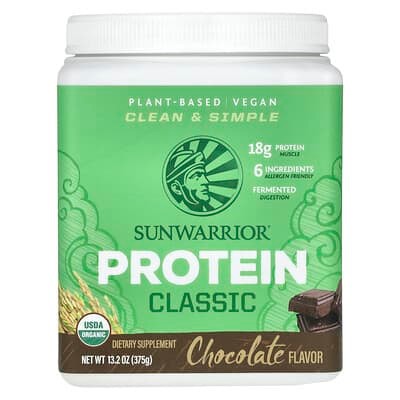
Classic Protein Chocolate

4.1
★ ★ ★ ★ ★
(107 ratings)
Sodium 190 mg
Potassium 120 mg
Protein (unspecified) 18 Gram(s)
Rice Protein
Product Image
Score59
Lean plant protein is appealing, but the unknown source, low potassium, and smaller package reduce confidence and value.
How scoring works
Powder
Quantity:375 Gram(s) • (15 servings)
Goals:

Score 59

Lean plant protein is appealing, but the unknown source, low potassium, and smaller package reduce confidence and value.
How scoring works
$26.97($1.79 per serving)
iHerb
$ 26.97
Vitacost
$ 29.65
Report prices

Analysis

A serving provides 18 g of protein in 100 calories, with only 1.5 g of fat and 4 g of carbohydrate. It is a simple way to add plant protein without a heavy macronutrient load.

Protein quality is harder to judge because the supplied data does not name the plant source or show an amino-acid profile. The 120 mg potassium amount is lower than the 190 mg sodium amount, which weakens its fit for heart-focused mineral balance.

The smaller package may suit occasional use or someone trying the flavor, but it is less efficient for regular supplementation. Choose it for its compact plant-protein serving rather than for electrolyte support or detailed formulation transparency.

Who is it for
  • Occasional users of plant-based protein powder
  • People who want a compact, low-calorie shake
Best for
  • Trying a plant-protein powder in a smaller package
  • Adding protein with little fat

Pros

  • Supplies 18 g of plant protein
  • Provides only 100 calories
  • Keeps fat and carbohydrate low

Cons

  • Does not identify the plant protein source
  • No amino-acid profile is supplied
  • Potassium is lower than sodium
  • Smaller package is less efficient for regular use

Nutrient quality

74 High impact

A lean macronutrient profile and moderate protein amount fit basic plant-protein use. Missing plant sources, amino-acid detail, and mineral forms limit quality confidence, while potassium is low.
Ingredient transparency

53 Moderate impact

The nutrition panel clearly states protein, macronutrient, sodium, and potassium amounts. The underlying protein ingredients, serving directions, and non-active ingredients are missing from the supplied details.

Customer satisfaction

46 Lower impact

The supplied average rating is mixed and is supported by small review count. No detailed feedback is available to assess repeated complaints or purpose-specific experiences.

Value for money

62 Moderate impact

The lean plant-protein profile provides limited value in the smaller package. Moderate protein, missing source details, and weak package economics reduce competitiveness.

Report analysis

Ingredients

IngredientAmount per serving
Calories
100 Calorie(s)
Total Fat
1.5 Gram(s)
Total Carbohydrates
4 Gram(s)
Protein
18 Gram(s)
Calcium
20 mg
Iron
1.7 mg
Sodium
190 mg
Potassium
120 mg
Gluten Free Adults 18–50 Vegan Kosher Dairy Free Organic Vegetarian
Report overview
Sodium · 190 mg OverallScore51
D Active Ingredient Quality & BioavailabilityC- Dose, Safety & Label TransparencyD+ Value

Its 190 mg sodium amount is too low for dependable replacement during intense exercise. The sodium source and supporting mineral forms are not fully identified, and no buffering mineral is shown. The protein-focused serving supplies some sodium but remains too light for demanding sweat replacement.

Potassium · 120 mg OverallScore25
F Active Ingredient Quality & BioavailabilityD+ Dose, Safety & Label TransparencyF Value

Potassium appears at a low amount, and the chemical source is not disclosed. The mineral is incidental to the plant protein, making the high serving cost poor value for potassium. A single value likely reflects elemental content, but no compound or yield detail is given.

Loading alternative details
Report alternatives

Sources

Published studies used for the product analysis and the top-ranked studies for each ingredient and goal.

  1. Potassium intake, stroke, and cardiovascular disease a meta-analysis of prospective studies.
    D'Elia L; Barba G; Cappuccio FP; Strazzullo P · Journal of the American College of Cardiology · 2011
    Meta-analysis247,510 participants11 studies pooledHeart Health forPotassium
  2. Oral potassium supplementation for management of essential hypertension: A meta-analysis of randomized controlled trials.
    Poorolajal J; Zeraati F; Soltanian AR; Sheikh V; Hooshmand E; Maleki A · PloS one · 2017
    Meta-analysis1,213 participants23 studies pooledHeart Health forPotassium
  3. Effect of Potassium Supplementation on Endothelial Function: A Systematic Review and Meta-Analysis of Intervention Studies.
    D'Elia L; Cappuccio FP; Masulli M; La Fata E; Rendina D; Galletti F · Nutrients · 2023
    Meta-analysis332 participants5 studies pooledHeart Health forPotassium
  4. Associations between sodium, potassium, and blood pressure: results from the Hispanic Community Health Study/Study of Latinos, a prospective cohort study.
    Swift SL; Sotres-Alvarez D; Raij L; Wassertheil-Smoller S; Schneiderman N; Llabre M; Zeki Al Hazzouri A; Rundek T; Van Horn L; Daviglus M; Castaneda S; Youngblood M; Mossavar-Rahmani Y; Elfassy T · The American journal of clinical nutrition · 2024
    Cohort study11,429 participantsHeart Health forPotassium
  5. Long-Term Potassium Monitoring and Dynamics in Heart Failure and Risk of Mortality.
    Núñez J; Bayés-Genís A; Zannad F; Rossignol P; Núñez E; Bodí V; Miñana G; Santas E; Chorro FJ; Mollar A; Carratalá A; Navarro J; Górriz JL; Lupón J; Husser O; Metra M; Sanchis J · Circulation · 2019
    Cohort study2,164 participantsHeart Health forPotassium
  6. Effect of high potassium diet on endothelial function.
    Blanch N; Clifton PM; Petersen KS; Willoughby SR; Keogh JB · Nutrition, metabolism, and cardiovascular diseases : NMCD · 2015
    Randomized trial35 participantsHeart Health forPotassium