

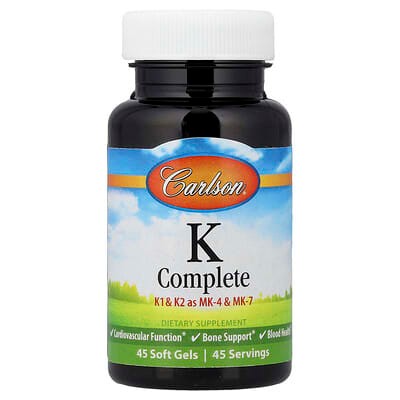
Nutrient quality
Three vitamin K forms provide broad and purposeful coverage. The high total amount and relatively modest MK-4 dose make the profile somewhat uneven.
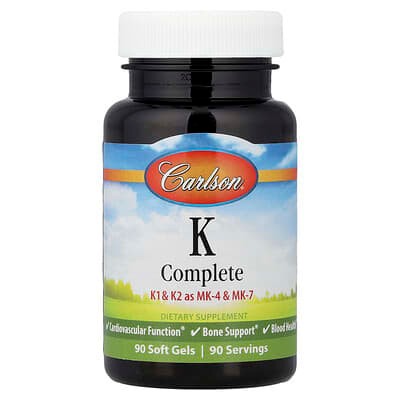
.
 iHerb iHerb | $ 44.63 | |
 Pure Formulas Pure Formulas | $ 44.63 |
K1 at 500 mcg, MK-4 at 1.5 mg, and MK-7 at 45 mcg provide three distinct forms in one serving. The mix offers more complete vitamin K coverage than a single-form product.
Each form is quantified, and softgel delivery is well suited to these fat-soluble nutrients. The larger count improves convenience without changing the conservative MK-7 exposure.
It works best for someone deliberately seeking K1 and both major K2 subtypes. People focused only on MK-7 may find a simpler, higher-dose formula more direct.
Three vitamin K forms provide broad and purposeful coverage. The high total amount and relatively modest MK-4 dose make the profile somewhat uneven.
.All vitamin K forms and amounts are clearly disclosed without hidden blends. Missing directions and softgel excipients are the main gaps.
.Aggregate satisfaction is strong and based on a limited evidence base. No firsthand experience details are supplied, so recurring complaints and purpose alignment cannot be checked.
.Useful forms and a sound serving position support good value. The package remains competitive in its category.
.
Three forms of vitamin K provide focused support for proteins that bind and direct calcium in bone. The combination includes both MK-4 and the longer-lasting MK-7 form.
The doses are clearly disclosed and appear meaningful for this pathway. Calcium, vitamin D, magnesium, and protein-matrix support are absent, so the formula covers only one part of bone nutrition.

Multiple vitamin K forms target calcium handling and give the formula a clear vascular-health rationale. Human evidence supports effects on vitamin K status and calcification markers, while proof of fewer cardiovascular events remains limited.
MK-4, MK-7, and K1 are all supplied at meaningful amounts. The three K forms are compatible, but they can oppose warfarin and other vitamin K antagonist anticoagulants.

The combination provides three disclosed vitamin K forms that support normal calcium handling and bone-related proteins. Including K1 with two K2 forms gives focused, evidence-based coverage of vitamin K activity.
The formula remains narrow and does not cover broader daily nutrition needs on its own. Vitamin K can oppose warfarin and similar anticoagulants, so people using those medicines need clinician-guided intake.

Vitamin K1, MK-4, and MK-7 provide comprehensive vitamin K coverage for calcium regulation and vascular proteins. The formula remains focused on one heart-relevant pathway rather than broader lipid or cardiac-energy support.
All three forms are clearly quantified, with substantial MK-4 and a moderate MK-7 amount. Vitamin K can counteract warfarin and other vitamin K antagonist medicines, so users of those drugs need clinician-guided intake.

K1, MK-4, and MK-7 provide broad vitamin K coverage for bone proteins and calcium handling. The formula is relevant to structural aging, though evidence does not establish broad healthspan effects by itself.
All three forms and amounts are clearly disclosed, with substantial K1 and MK-4 but a modest MK-7 amount. Vitamin K can oppose warfarin and related anticoagulants, so stable intake and prescriber guidance are essential for users of those medicines.
| Ingredient | Amount per serving |
|---|---|
Vitamin K1 | 500 mcg |
Vitamin K2 (MK-4) | 1.5 mg |
Vitamin K2 (MK-7) | 45 mcg |
The softgel clearly combines K1, high-dose MK-4, and a maintenance amount of generic MK-7. Lipid-compatible delivery supports absorption, though the MK-7 amount remains below the clinical range. The larger package provides fair value, and warfarin users need consistent intake with clinician guidance.
Published studies used for the product analysis and the top-ranked studies for each ingredient and goal.