
Nutrient quality
Clear EPA and DHA amounts provide some targeted value. Low concentration and a potentially dangerous stated vitamin D3 amount make the formulation unsuitable without verification.
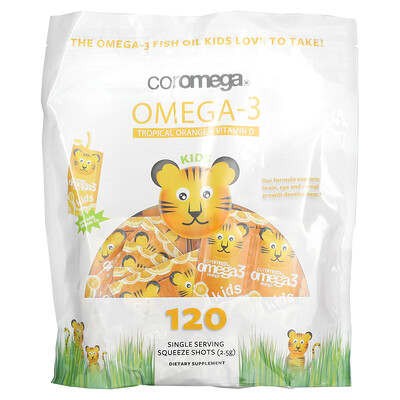
 iHerb iHerb | $ 47.43 |
A serving lists 650 mg total omega-3s with 250 mg EPA and 230 mg DHA, which is a meaningful child-focused amount. The formula also lists vitamin C and vitamin D3, but the displayed 5 mg vitamin D3 entry is far outside normal supplement labeling and may reflect a unit error.
Do not give the product to a child until the original package confirms the vitamin D amount and unit. A true milligram-level amount would be unsafe, while a microgram value would change the assessment completely.
The squeeze format may be easier than capsules, but fish species, molecular form, independent purity results, oxidation protection, and complete inactive ingredients are not supplied. The unresolved vitamin D discrepancy makes those secondary concerns.
Clear EPA and DHA amounts provide some targeted value. Low concentration and a potentially dangerous stated vitamin D3 amount make the formulation unsuitable without verification.
Active fatty-acid quantities are clearly disclosed without a hidden blend. Missing full directions, excipients, and some oil-quality details reduce completeness.
The supplied average rating is very strong and the rating volume is moderate. No specific experience details were provided to judge repeated complaints or purpose alignment.
Quality, dose, or safety limitations weaken practical value. Better-dosed or safer alternatives are more competitive.

EPA and DHA give the children’s formula a direct inflammation-resolving pathway, with vitamin D intended as complementary immune support. The combined 480 mg EPA and DHA amount is moderate but meaningful for a child-focused product.
The supplied data lists vitamin D at 5 mg, an implausibly high amount that prevents a safe assessment of the formula. Verify the original label unit before use because a true milligram-level vitamin D dose could cause dangerous calcium elevation.

EPA and DHA may support skin-barrier lipids and inflammatory balance. The serving lists 250 mg EPA and 230 mg DHA within 650 mg total omega-3 fatty acids.
The omega-3 amounts are useful, but the displayed 5 mg vitamin D3 amount would be dangerously excessive and requires label verification before use. Do not use it for a child unless the vitamin D unit and amount are confirmed.

Fish Oil provides a relevant route to cardiovascular support. Dose or form uncertainty limits confidence in the practical contribution.
The formula remains narrow rather than comprehensive. Vitamin K can oppose warfarin and related vitamin-K-antagonist medicines, so the intake should remain medically coordinated and consistent.

EPA and DHA provide moderate retinal and ocular surface support in a child-focused format. The formula lacks lutein, zeaxanthin, zinc, and broader macular antioxidant coverage.
The listed vitamin D3 unit is unusually large and should be verified against the package before use. Fatty-acid amounts are clear, but molecular form, contaminant testing, and oxidation protection are not disclosed.
| Ingredient | Amount per serving |
|---|---|
Calories | 20 Calorie(s) |
Total Fat | 2 Gram(s) |
Saturated Fat | 0.5 Gram(s) |
Cholesterol | 10 mg |
Vitamin C | 12 mg |
Vitamin D3 | 5 mg |
Fish Oil | 2000 mg |
Omega-3 Fatty Acids | 650 mg |
Eicosapentaenoic Acid | 250 mg |
Docosahexaenoic Acid | 230 mg |
Stevia Leaf Extract | 10 mg |
The generic fish-oil source does not disclose its molecular form or dedicated antioxidant protection. EPA and DHA are listed separately, but their combined amount is a small share of the total fish oil and no independent purity standard is shown. Cost per active gram is moderately competitive because the combined EPA and DHA amount is clearly calculable.
The serving provides 250 mg EPA, and epa is only modestly higher than dha. EPA forms a small share of the fish oil, but the molecular form and contaminant-testing status are not disclosed. EPA cost efficiency is moderate, while no oil-protection antioxidant is listed.
EPA and DHA are individually disclosed, but their combined amount is low and represents less than one-quarter of the fish oil. The fish species and molecular form are not identified, and no purification, independent testing, or antioxidant stabilizer is stated. Average active-omega-3 value does not overcome the weak concentration and limited quality disclosure.
Published studies used for the product analysis and the top-ranked studies for each ingredient and goal.