Nutrient quality
The formula relies on conventional thiamine, pyridoxine, folic acid, and cyanocobalamin forms. Niacin is relatively high for routine use, while vitamin B6 remains moderate.
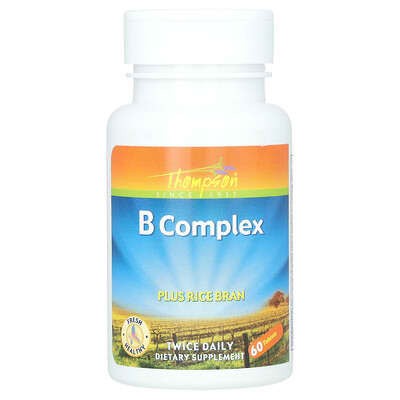
.
 iHerb iHerb | $ 3.99 | |
 Vitacost Vitacost | $ 3.99 |
The formula covers all core B vitamins and is most useful as basic nutritional backup. Thiamine, riboflavin, niacinamide, vitamin B6, folic acid, B12, and pantothenic acid are all stated individually.
Most forms are conventional rather than active or premium forms. Choline bitartrate contributes only 50 mg, while 20 mcg of biotin and 5 mg of inositol are too small to make this a serious hair or choline product.
Two tablets per serving are manageable, and the low cost supports routine use. It fits adults seeking a simple B complex, but users wanting methylfolate, methylcobalamin, active B6, or meaningful hair support should choose a different formula.
The formula relies on conventional thiamine, pyridoxine, folic acid, and cyanocobalamin forms. Niacin is relatively high for routine use, while vitamin B6 remains moderate.
.Specific amounts are supplied for every listed active ingredient. No proprietary blend hides the listed doses.
.The supplied aggregate rating is very strong. No complaint themes or purpose-specific experience details are supplied.
.The formula and favorable qualitative positioning support strong value. Choline is modest and inositol is too small to contribute much.
.
Broad B-vitamin coverage supports normal energy metabolism and several basic cellular processes. Most nutrients are present in useful amounts rather than token traces.
Folic acid and cyanocobalamin require conversion and provide less direct form quality than methylated alternatives. The formula remains a practical basic B-complex but is not optimized for users specifically seeking active folate or B12.
A basic B-complex supplies thiamine, riboflavin, niacin, B6, folate, B12, and pantothenic acid for normal energy metabolism. Most amounts are suited to maintenance rather than targeted fatigue support.
Cyanocobalamin and ordinary vitamin forms limit quality, while B12 is especially low for the stated goal. Choline and inositol add little at their listed amounts.
| Ingredient | Amount per serving |
|---|---|
Thiamine (Thiamine Mononitrate) | 9.5 mg |
Riboflavin (Vitamin B2) | 10 mg |
Niacin (Niacinamide) | 50 mg |
Vitamin B6 (Pyridoxine Hydrochloride) | 8.2 mg |
Folic Acid | 400 mcg |
Vitamin B12 (Cyanocobalamin) | 10 mcg |
Biotin | 20 mcg |
Pantothenic Acid (Calcium D-Pantothenate) | 13 mg |
Calcium (Calcium Carbonate) | 56 mg |
Choline Bitartrate | 50 mg |
Inositol | 5 mg |
Niacinamide is clearly identified at an amount that fits a B-complex. The hard-pressed tablet lacks a stated release feature, and the label does not specifically call out its non-flushing nature. Its low serving cost provides good practical value for a broad B-vitamin formula.
The disclosed thiamine mononitrate is a standard form with a low amount for a targeted metabolism goal. The label clearly identifies the active dose, but the conventional tablet adds no absorption advantage. A low serving cost is offset by limited thiamin delivered per serving.
The 10 mg standard riboflavin dose is suited to maintenance rather than high-potency support. A pressed tablet and non-active vitamin form limit delivery quality. Very low serving cost partly compensates for the modest dose.
Published studies used for the product analysis and the top-ranked studies for each ingredient and goal.