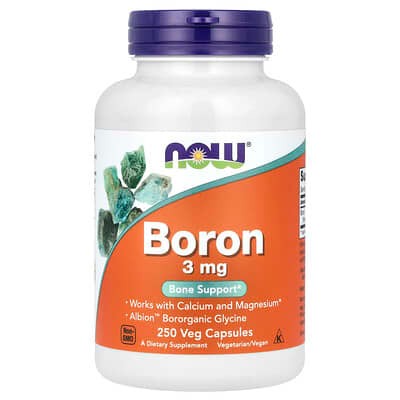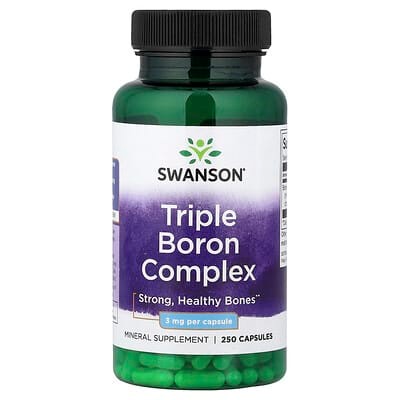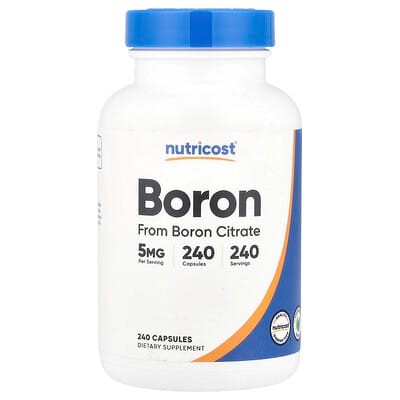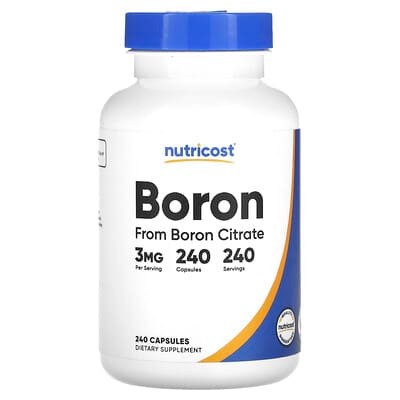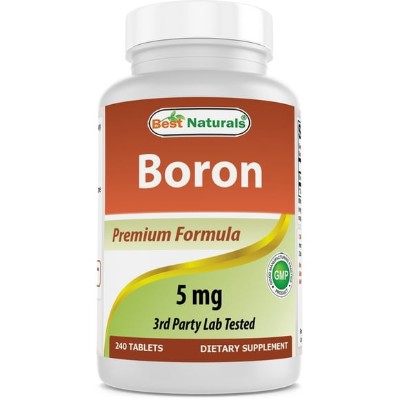
Boron

mineral

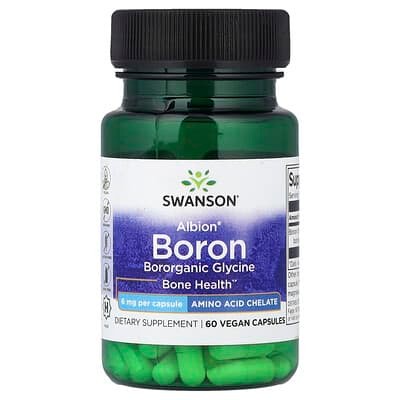
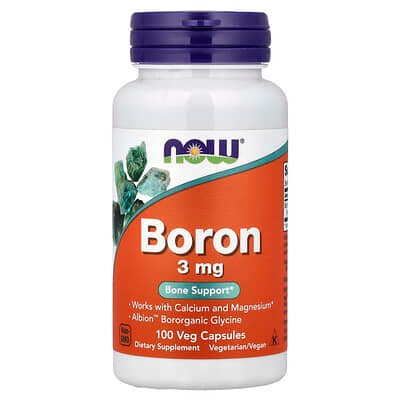
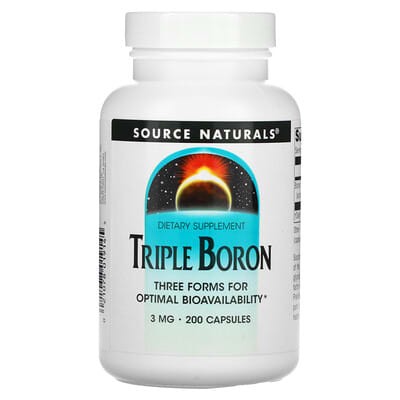
Boron is a trace mineral that contributes to skeletal integrity by supporting the metabolism of calcium, magnesium, and vitamin D. It helps facilitate the absorption of these nutrients and may help prevent their loss from the body. This role is important for maintaining bone density and overall skeletal health. This mineral influences the activity of steroid hormones, including estrogen and testosterone, which can affect reproductive health and metabolic function. Research has also explored its potential to support brain function, with some findings suggesting it may support cognitive performance and hand-eye coordination. Boron possesses antioxidant and anti-inflammatory properties that support cellular health. It is also involved in immune system modulation and wound healing, though further research continues to explore the full extent of its biological mechanisms.

Natural sources
Fruits (apples, pears, grapes, dates, raisins, avocado)Vegetables (leafy greens, potatoes, carrots, broccoli)Nuts and seedsLegumes (beans, lentils)Wine and coffee

Ingredient forms

No public comparison lists found.

Timing & Intake
AnytimeWith foodTake with Food to minimize potential stomach upset.
Optimal Dosage
Minimum1 mg
Maximum6 mg
Safety & Toxicity
Toxicity Threshold20 mg
Toxicity EffectHormonal imbalance, reproductive toxicity
4 safety notes
  • Pregnant or breastfeeding individuals should consult a healthcare professional before use.
  • Individuals with kidney disease should use with caution and under medical supervision.
  • Avoid excessive doses as high intake can lead to boron toxicity (borism), characterized by digestive issues, skin conditions, and neurological symptoms.
  • Not recommended for individuals with hormone-sensitive conditions without medical advice due to its influence on hormone levels.
Goals
Bone Health
Impact
High effect
Typical dose:1–6 mg
Boron is a trace mineral that has a significant impact on bone metabolism. It influences the production and activity of steroid hormones, including estrogen and testosterone, which are important for maintaining bone density in both men and women.

Study evidence

5 studies

Boron influences mineral metabolism, which may be relevant to bone health, but the available research does not establish stronger bones or fewer fractures from supplementation. Findings mostly concern mineral handling and vary with magnesium intake, rather than demonstrating a consistent bone-density benefit.

View goal

General Health
Impact
High effect
Typical dose:3–10 mg
Boron plays a key role in mineral metabolism, reducing the urinary excretion of calcium and magnesium. It also enhances the half-life and bioavailability of vitamin D and estrogen, making it crucial for maintaining strong bones and comfortable joints, particularly as we age.

Study evidence

6 studies

Boron has limited evidence for specific effects, including reduced menstrual pain and changes in inflammatory or blood-fat markers. These findings do not establish broad general-health benefits, and research on boron-containing medicines or cancer treatments cannot be applied to ordinary boron supplements.

View goal
Testosterone Support
Impact
High effect
Typical dose:3–10 mg
The evidence for Boron's ability to significantly decrease Sex Hormone-Binding Globulin (SHBG) and thereby increase free testosterone is quite robust, especially in the short term. This places its efficacy above other situational botanicals.

Study evidence

3 studies

Boron has inconsistent evidence for increasing testosterone. Hormonal changes in uncontrolled research and during recovery from a low-boron diet contrast with a placebo-controlled study showing no testosterone benefit, so the available evidence does not establish reliable testosterone support in adequately nourished men.

View goal
Anti-Aging
Impact
Situational effect
Typical dose:3–10 mg
Boron plays an underappreciated role in healthy aging. It reduces the excretion of calcium and magnesium, supporting bone density. It also has anti-inflammatory properties and positively influences the activity of crucial hormones and vitamins that often decline or are dysregulated with age.

Study evidence

No published studies for this goal yet.

View goal
Joint Health
Impact
Situational effect
Typical dose:3–10 mg
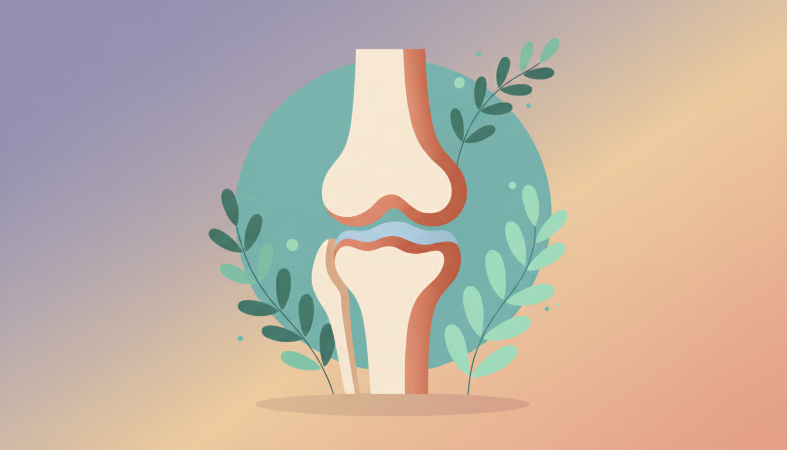
Populations with low dietary boron intake tend to have higher rates of arthritis. Supplementation has been shown to reduce inflammatory markers like hs-CRP and TNF-α, and may improve the body's use of Vitamin D.

Study evidence

3 studies

Boron-containing supplements show preliminary promise for easing joint discomfort, especially knee symptoms. The evidence is limited and largely concerns calcium fructoborate or small studies, so it does not establish that boron broadly protects joints or prevents arthritis.

View goal

Studies

Research connections will load here.
Sources

Up to five highest-ranked published examples per goal. Study counts and charts include all published studies for the connection.

  1. [Comparative study of the urinary excretion of boron, calcium, magnesium and phosphorus in postmenopausal women with and without osteoporosis].
    José Ramón V; Mora Mora M; Marino Alarcón O; Hernández G; Josefina Linares L; Urdaneta Romero H; Arévalo González E · Investigacion clinica · 2013
    Case-control study45 participantsBone Health
  2. Effect of dietary boron on mineral, estrogen, and testosterone metabolism in postmenopausal women.
    Nielsen FH; Hunt CD; Mullen LM; Hunt JR · FASEB journal : official publication of the Federation of American Societies for Experimental Biology · 1987
    Single-arm trial12 participantsBone Health
  3. The relationship between boron and magnesium status and bone mineral density in the human: a review.
    Volpe SL; Taper LJ; Meacham S · Magnesium research · 1994
    Narrative reviewBone Health
  4. Effects of boron supplementation on bone mineral density and dietary, blood, and urinary calcium, phosphorus, magnesium, and boron in female athletes.
    Meacham SL; Taper LJ; Volpe SL · Environmental health perspectives · 1995
    Randomized trial28 participantsBone Health
  5. Metabolic responses of postmenopausal women to supplemental dietary boron and aluminum during usual and low magnesium intake: boron, calcium, and magnesium absorption and retention and blood mineral concentrations
    C D Hunt, J L Herbel, F H Nielsen · The American Journal of Clinical Nutrition · 1997
    Non-randomized trial11 participantsBone Health
  6. Effects of boron supplementation on the severity and duration of pain in primary dysmenorrhea.
    Nikkhah S; Dolatian M; Naghii MR; Zaeri F; Taheri SM · Complementary therapies in clinical practice · 2015
    Randomized trial113 participantsGeneral Health
  7. Efficacy and safety of tavaborole topical solution, 5%, a novel boron-based antifungal agent, for the treatment of toenail onychomycosis: Results from 2 randomized phase-III studies.
    Elewski BE; Aly R; Baldwin SL; González Soto RF; Rich P; Weisfeld M; Wiltz H; Zane LT; Pollak R · Journal of the American Academy of Dermatology · 2015
    Randomized trialGeneral Health
  8. The efficacy and safety of tavaborole, a novel, boron-based pharmaceutical agent: phase 2 studies conducted for the topical treatment of toenail onychomycosis.
    Toledo-Bahena ME; Bucko A; Ocampo-Candiani J; Herz-Ruelas ME; Jones TM; Jarratt MT; Pollak RA; Zane LT · Journal of drugs in dermatology : JDD · 2015
    Clinical trial336 participantsGeneral Health
  9. Boron neutron capture therapy (BNCT) for glioblastoma multiforme: a phase II study evaluating a prolonged high-dose of boronophenylalanine (BPA).
    Henriksson R; Capala J; Michanek A; Lindahl SA; Salford LG; Franzén L; Blomquist E; Westlin JE; Bergenheim AT; Swedish Brain Tumour Study Group · Radiotherapy and oncology : journal of the European Society for Therapeutic Radiology and Oncology · 2009
    Single-arm trial30 participantsGeneral Health
  10. Effects of Calcium Fructoborate on Levels of C-Reactive Protein, Total Cholesterol, Low-Density Lipoprotein, Triglycerides, IL-1β, IL-6, and MCP-1: a Double-blind, Placebo-controlled Clinical Study
    Otilia-Constantina Rogoveanu, George Dan Mogosanu, Cornelia Bejenaru, Ludovic Everard Bejenaru, Octavian Croitoru, Johny Neamtu, Zbigniew Pietrzkowski, Tania Reyes-Izquierdo, Andrei Bita, Iulia Daria Scorei, Romulus Ion Scorei · Biological Trace Element Research · 2015
    Randomized trial78 participantsGeneral Health
  11. Biochemical and physiologic consequences of boron deprivation in humans.
    Nielsen FH · Environmental health perspectives · 1995
    Single-arm trial12 participantsTestosterone Support
  12. Plasma boron and the effects of boron supplementation in males.
    Green NR; Ferrando AA · Environmental health perspectives · 1995
    Randomized trial19 participantsTestosterone Support
  13. Comparative effects of daily and weekly boron supplementation on plasma steroid hormones and proinflammatory cytokines
    Mohammad Reza Naghii, Mahmoud Mofid, Ali Reza Asgari, Mehdi Hedayati, Maryam-Saddat Daneshpour · Journal of Trace Elements in Medicine and Biology · 2011
    Non-randomized trial8 participantsTestosterone Support
  14. Essentiality of boron for healthy bones and joints.
    Newnham RE · Environmental health perspectives · 1995
    Randomized trial20 participantsJoint Health
  15. Short-term efficacy of calcium fructoborate on subjects with knee discomfort: a comparative, double-blind, placebo-controlled clinical study
    Zbigniew Pietrzkowski, Michael J Phelan, Robert Keller, Cynthia Shu, Ruby Argumedo, Tania Reyes-Izquierdo · Clinical Interventions in Aging · 2014
    Randomized trial60 participantsJoint Health
  16. A double-blind, placebo-controlled pilot study to evaluate the effect of calcium fructoborate on systemic inflammation and dyslipidemia markers for middle-aged people with primary osteoarthritis
    Romulus Scorei, Paul Mitrut, Iulian Petrisor, Iulia Scorei · Biological Trace Element Research · 2011
    Randomized trial60 participantsJoint Health