
Nutrient quality
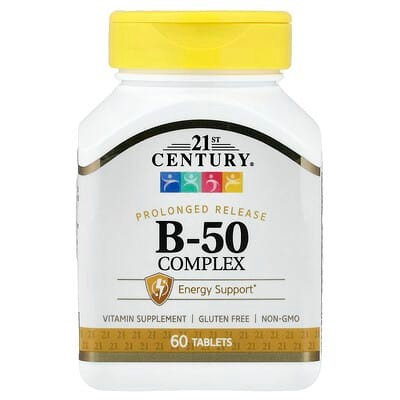
The formula relies on conventional forms such as pyridoxine, cyanocobalamin, and thiamine mononitrate. Most core B vitamins are substantial, while pantothenic acid is more modest.
.
 Amazon Amazon | $ 12.74 | |
 Pure Formulas Pure Formulas | $ 5.37 | |
 iHerb iHerb | $ 6.49 |
The tablet supplies the core B vitamins in amounts well above basic daily requirements. It can help cover gaps and support the metabolic reactions that convert food into usable energy.
Most vitamins use standard forms rather than active coenzyme forms. Duplicate thiamine and calcium entries reduce label clarity and make the presentation harder to interpret.
Serving value is a clear strength for shoppers who specifically want a B-50 formula. Daily B6 at 50 mg is better suited to deliberate use than an indefinite, stackable wellness routine.
The formula relies on conventional forms such as pyridoxine, cyanocobalamin, and thiamine mononitrate. Most core B vitamins are substantial, while pantothenic acid is more modest.
.Core vitamins are quantified, though duplicate thiamine and calcium entries create ambiguity. A complete inactive ingredient list was not supplied.
.The available aggregate rating is reasonably strong for this category. No firsthand outcome details were supplied, so alignment with the intended use is uncertain.
.The broad nutrient coverage provides good quality for a very low serving cost. The product is highly competitive among budget B-complex tablets.
.
High-potency thiamine, riboflavin, niacinamide, and vitamin B6 support the metabolic steps that turn food into usable energy. Benefit is most likely when intake or status is inadequate rather than as an immediate stimulant effect.
The formula uses standard vitamin forms, including cyanocobalamin rather than an active B12 form. Prolonged daily use of the 50 mg vitamin B6 amount may contribute to tingling, numbness, or other nerve symptoms in susceptible users.

A broad set of B vitamins supports normal energy metabolism by helping enzymes process carbohydrate, fat, and protein. The large amounts provide nutritional depth but do not directly raise metabolic rate in people who already have adequate status.
Coverage spans several cellular energy pathways, yet there is no thermogenic, mitochondrial transport, thyroid, or glycemic-control anchor. Standard forms are used for several vitamins, so the formula is more supportive than targeted.
| Ingredient | Amount per serving |
|---|---|
Thiamine (Vitamin B1, Thiamine Mononitrate) | 50 mg |
Riboflavin (Vitamin B2) | 50 mg |
Niacin (Niacinamide) | 50 mg |
Vitamin B6 (Pyridoxine Hydrochloride) | 50 mg |
Folate | 667 mcg DFE |
Vitamin B12 (Cyanocobalamin) | 50 mcg |
Biotin | 50 mcg |
Pantothenic Acid (D-Calcium Pantothenate) | 10 mg |
Calcium (Calcium Carbonate, Dicalcium Phosphate) | 130 mg |
Niacinamide supplies an appropriate amount for a general B-complex and is clearly identified. The tablet has no stated release technology or explicit no-flush wording. Its very low serving cost makes it economical for routine B-vitamin use.
The inexpensive B-complex provides a preferred-range B6 dose in one tablet. Its B6 is pyridoxine hydrochloride rather than active P-5-P, although riboflavin is included as part of the complex. Clear labeling and simple dosing support practical use.
The disclosed mononitrate reaches the lower edge of the targeted high-potency range in a broad B-complex. Its standard form and tablet delivery provide no premium bioavailability feature. Low serving cost is offset by a less favorable cost per active thiamin amount.
Published studies used for the product analysis and the top-ranked studies for each ingredient and goal.