
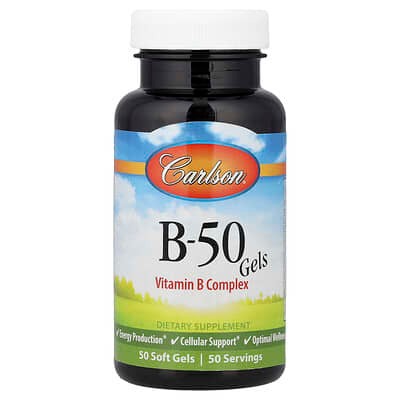
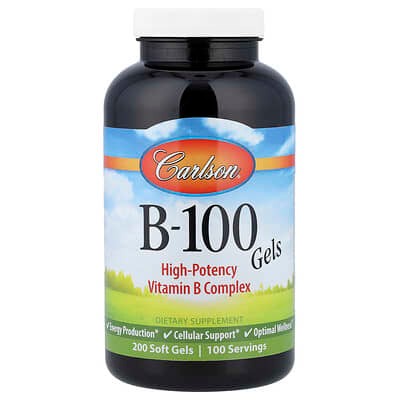
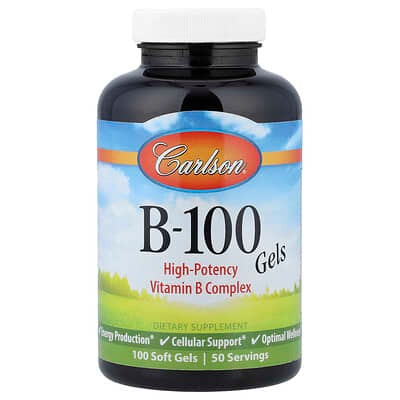
Nutrient quality
The formula relies on thiamine mononitrate, pyridoxine hydrochloride, cyanocobalamin, and other conventional forms. The high vitamin B6 amount creates a meaningful neuropathy concern with long-term use.
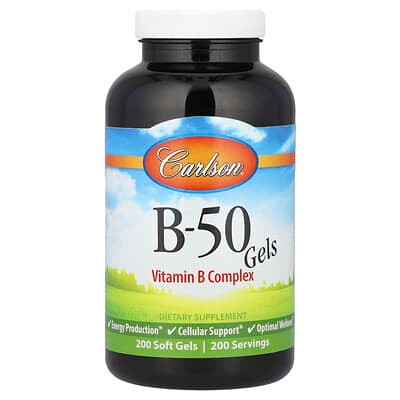
.
 iHerb iHerb | $ 48.37 | |
 Vitacost Vitacost | $ 48.37 | |
 Amazon Amazon | $ 48.37 | |
| Vitacost | $ 48.37 |
Thiamine, riboflavin, niacinamide, B6, folate, B12, biotin, and pantothenic acid are all supplied at high amounts. Soy-derived phosphatidylcholine adds a small lipid-based choline component to the softgel.
The formula relies on thiamine mononitrate, pyridoxine hydrochloride, cyanocobalamin, and unspecified folate rather than active forms. Softgel delivery does not materially solve those form limitations for water-soluble vitamins.
Vitamin B6 at 50 mg is excessive for routine maintenance and can become a long-term nerve-safety concern. The larger bottle offers reasonable value, but dose suitability matters more than package economy.
The formula relies on thiamine mononitrate, pyridoxine hydrochloride, cyanocobalamin, and other conventional forms. The high vitamin B6 amount creates a meaningful neuropathy concern with long-term use.
.Specific amounts are supplied for every listed active ingredient. No proprietary blend hides the listed doses.
.The supplied aggregate rating is strong. No complaint themes or purpose-specific experience details are supplied.
.Quality or dose limitations weaken the premium position. Phosphatidylcholine is relevant, while the softgel fat and protein add little active value.
.
A complete B-complex supports the nutrient-dependent steps that convert food into cellular energy. High amounts of thiamin, riboflavin, niacin, and pantothenic acid provide focused metabolic coverage.
Standard vitamin forms and a B12 amount below the targeted energy threshold limit the advantage over basic deficiency support. The concentrated vitamin B6 amount also makes long-term daily use less suitable without a clear need.
No linked studies yet.

The high-potency B-vitamin blend supplies several cofactors used to turn food into cellular energy. Its role is foundational, so it is more relevant to correcting inadequate intake than directly raising metabolic rate.
Amounts are substantial and fully disclosed, but most vitamins use standard precursor forms. The focused formula is coherent, although it does not cover thermogenesis, thyroid support, or glycemic control.
| Ingredient | Amount per serving |
|---|---|
Calories | 10 Calorie(s) |
Total Fat | 1 Gram(s) |
Protein | 1 Gram(s) |
Thiamine (Thiamine Mononitrate, Vitamin B1) | 50 mg |
Riboflavin (Vitamin B2) | 50 mg |
Niacin (Niacinamide) | 50 mg |
Vitamin B6 (Pyridoxine Hydrochloride) | 50 mg |
Folate | 680 mcg DFE |
Vitamin B12 (Cyanocobalamin) | 50 mcg |
Biotin | 50 mcg |
Pantothenic Acid (D-Calcium Pantothenate) | 50 mg |
Phosphatidyl Choline (Soybeans) | 50 mg |
Pyridoxine hydrochloride is less direct than active P-5-P, but riboflavin may support its conversion. The 50 mg serving is at the upper edge of the preferred range and is delivered in one softgel. Low serving cost provides strong value.
The B-complex uses clearly named niacinamide at a useful general-support amount. Its conventional softgel delivery has no special release feature, while niacinamide itself has low flush potential. The serving cost is favorable for the included B-vitamin profile.
Standard riboflavin requires enzymatic conversion before it becomes metabolically active, while the softgel format supports fast release. The amount reaches the high-potency range for metabolic support. The low serving cost makes the clearly stated dose highly efficient.
Published studies used for the product analysis and the top-ranked studies for each ingredient and goal.